Saturday, 17 March 2012

Pawapuri Jal Mandir of Mahavir Swami

Pawapuri was at this place that Lord Mahavira, the twenty fourth Tirthankar attained “Nirvana” or eternal salvation from the cycle of death and birth in the year 527 BC. The Pictures shows the “Charan Paduka” housed in Jal Mandir, one of the 5 main temples in Pawapuri. It marks the spot where the mortal remains of the Lord Mahavira was creamated.

Pawapuri is situated in Bihar, India and its proximity to the capital city, Patna makes it approachable to pilgrims and tourists alike. It is situated on the Patna-Ranchi road and can be approached either from Nawadah or Bihar Sharif.

During ancient times about 2600 year ago, Pawapuri was the part of Magadha Kingdom and was called “Madyama Pawa” or “Apawapuri”, Ajatshatru, the son of King Shrenik who was one of the greatest disciples of Lord Mahavira was the King of Magadh during the lifetime of Mahavir. During the reign of Ajatshatru King Hastipal was the King of Pawapuri. When Lord Mahavira came to Pawapuri he stayed in King Hastipal’s “Rajikshala”.

There are five main temples in Pawapuri – the Jal Mandir,the Gaon Mandir,the Samosaran,the New Samosaran and another temple built by Bibi Mehetab Kumari. Apart from these temples there is a Digamber Mandir near Jal mandir.


jal-mandir-featured

Jal mandir as the name suggests is a temple in the middle of a lake blooming with lotuses. The main deity of the beautiful temple is a very old “Charan Paduka” of Lord Mahavira. It marks the spot where the mortal remains of Lord Mahavira was cremated. It is believed that this temple was built by King Nandivardhan, elder brother of Lord Mahavira.

Jal Mandir is built in the shape of “Vimana” and there is a stone bridge about 600 feet in length across it from the bank to the temple.
According to the legend, the concourse of the people who attended the funeral ceremony of Lord Mahavira , was so large that the mere act of their taking a pinch of ashes created such a big hollow over the place that it transformed into present tank.

The sheer beauty , along with the peace and tranquility of this temple is a treat to the eyes of the visitors.


DSC00248

The Gaon mandir or the village temple marks the spot where Lord Mahavira breathed his last. It is said that this temple was built by King Nandivardhan, elder brother of Lord Mahavira. It is at this spot where the Lord addressed his last preachings our “updesha” . This “updesha” was supposed to be attended by many people, from across the country and from different walks of life. Knowing that his end was not far, Mahavira started his last “updesha” . He continued to preach till he gained “Nirvana” . Unable to bear the loss of the Lord all the people present there illuminated “diyas” (lamps) fuelled by ghee to lighten the atmosphere of sorrow. This tradition has continued till day.

Gaon mandir has a big compound along with a huge Dharamshala with all the neccessary basic amneties catering to the comfort of the pilgrims. The dedicatory stone of the temple records the restoration of Pawapuri during the reign of Emperor Shah Jahan in 1641 AD by Swetamabri Sangh of Bihar under Acharya Jina RajaSuri

Click here for more detail

Wednesday, 7 March 2012

Sametshikhar Shikharji Parasnath Hill


Shikharji or Sametshikhar also known as the Parasnath Hill, located in Giridih district in Jharkhand, India, is a major Jain pilgrimage destination and is the most sacred place for Jains in the world. According to Jain belief, twenty of the twenty-four Tirthankaras (teachers of the Jains) attained Moksha (Nirvana) from this place. Parasnath Hill with a height of 1,350 metres (4,430 ft)) make up the highest mountain in the state of Jharkhand.


Shri Sammed Shikharji attracts pilgrims from across India.

The number of Tirthankars who attained nirvana at Shri Sammet Shikharji is 20. For each of them there is a shrine on the hill.

The hill is also known as Parasnath, a name derived from Parshva, the 23rd Tirthankara who attained Nirvana there. His present temple is not very old, although the idol in the main temple is ancient. The Sanskrit inscriptions at the foot of the images indicate that they were put in the temple in 1678 A.D.

Archaeologists believe some of the existing temple edifices on Parasnath Hill date from 1765 A.D. although the place is of greater antiquity. It is certain that the present edifices replace older edifices, which were demolished. Jain temples are often pulled down and re-built.

Each tirtha (pilgrimage site) represents centuries of devotion, which found expression in temple-building, and to this day are at the centre of pilgrimages and festivals at frequent intervals. Although many of the temples may seem complicated in appearance, each is designed on the principles common to the religious architecture of the late medieval period, the elaborations being due to such factors as the addition of supplementary shrines, second stories, and adding pillared cloisters around all the larger examples. One variation unique to Jain temples is the frequent production of a class of temple known as chaumukh, or four-faced.

There is a Temple of Bhomiyaji at the start of the Hills (Termed as Taleti) and it is said that once you bow your head at this temple and start the journey towards the top of the hill, there is no way you can be mislead in the journey. The moment you forget the way, there will be Dogs who will guide you the way and will soon disappear fast once you are back on track.


Tirthankaras attaining Nirvana at Shri Sammed Shikharji

Shri Ajitnath Ji
Shri Sambhavanath Ji
Shri Abhinandannath Ji
Shri Sumatinath Ji
Shri Padmaprabha Ji
Shri Suparshvanath Ji
Shri Chandraprabha Ji
Shri Suvidhinath Ji
Shri Sheetalnath Ji
Shri Shreyansanath Ji
Shri Vimalnath Ji
Shri Anantnath Ji
Shri Dharmanath Ji
Shri Shantinath Ji
Shri Kunthunath Ji
Shri Aranath Ji
Shri Mallinath Ji
Shri Munisuvrata Ji
Shri Naminatha ji
Shri Parshva Ji
One can also pay a visit to Palganj Ji, which is just 12 km away from Madhuban (place from where this journey begins). This temple has a sculpture of Shri Parasnath Bhagwan which was from 4th Century, also the priest of the temple narrates story about this temple which is worth to listen.


Shikharji temples

Following are temples at Shikharji. The actual temples are not numbered; hence there may be minor differences in the numbering of temples in various guidebooks and literature. The following numbering is based on the guidance provided by the local Shikharji resident supervisor.

Shri Gautam Swami (Ghandhar)
Shri Kunthunath Prabhu (17th Tirthankar)
Shashvat Jin Shri Rishbhanan Prabhu
Shashvat Jin Chandranan Prahbu
Shri Naminath Prabhu (21st Tirthankar)
Shri Arnath Prahbu (18th Tirthankar)
Shri Mallinath Prabhu (19th Tirthankar)
Shri Shreyansnath Prabhu (11th Tirthankar)
Shri Suvidhinath Prabhu (9th Tirthankar)
Shri Padam Prabhu (6th Tirthankar)
Shri Munisuvrat Prabhu (20th Tirthankar)
Shri Chandrah Prabhu (8th Tirthankar)
Shri Adinath Prabhu (1st Tirthankar)
Shri Anantnath Prabhu (14th Tirthankar)
Shri Sheetalnath Prabhu (10th Tirthankar)
Shri Sambhavnath Prabhu ( 3rd Tirthankar)
Shri Vasupujya Prabhu (12th Tirthankar)
Shri Abhinandan Prabhu ( 4th Tirthankar)
Shri Shubh Swami Ghandhar
Jal Mandir
Shri Dharamnath Prabhu (15th Tirthankar)
ShashvatJin Shri Vardhman Prabhu
ShashvatJin Shri Varishen Prabhu
Shri Sumatinath Prabhu (5th Tirthankar)
Shri Shantinath Prabhu (16th Tirthankar)
Shri Mahavir Prabhu (24th Tirthankar)
Shri SuParshavnath Prabhu (7th Tirthankar)
Shri Vimalnath Prabhu (13th Tirthankar)
Shri Ajitnath Prabhu (2nd Tirthankar)
Shri Neminath Prabhu (22nd Tirthankar)
Shri Parshavnath Prabhu (23rd Tirthankar)

click here for more detail

Palitana Shatrunjaya Giriraj


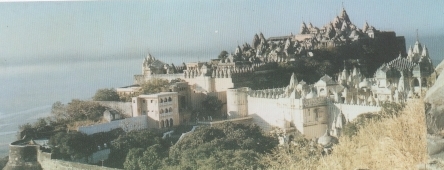
Palitana is located in Gujarat, 51 km south west of Bhavnagar. The town has a good road and rail network that connects it to the other cities of Gujarat. Bhavnagar, the nearest airport lies at a distance of 60 kilometer from Palitana. Siddha Kshetra Shri Shatrunjaya Teerth is situated on a hill, which is decorated by 3500 temples. Spires of the temples attract pilgrims from a far distance. Nagarjuna founded Palitana, which derives its name from Guru Padalipta or politta. The chief attraction here is the holy Jain shrine Shatrunjay Hill, 3 km away from the railway station.

On the top of the hill 873 temples were built of white marble, the work beginning in the 11th century and continuing for 900 long' years. However, destroyed by the Muslim invasions in 14th and 15th centuries, the temples were built anew in 1500. They are unique- in their architecture and sculpture. The ornamented temples look like ivory miniatures in the sunlight, seems to be wedding cake. Notable among the temples are Adinath, Kumarpal, Sampriti Raj, Bimal Shah. The holiest temple among the cluster, according to the Jain pilgrims, is the temple of Adishwar, the first Jain Tirthankar. It is also the most beautifully wrought. The marble image of the deity is bedecked with gold ornaments studded with precious jewels. The largest temple built in 1618 is that of 4-faced Adinath, the first Tirthankara.


Bhagawan AdishvarJain Teerth:

Steps :- 3364
Height:- 2000 ft
mile:- 7.5
Idols :- 27007
Jain Mandir :- 3507
Pagla:- 1500

It is on the Shetrunjaya Mountain at a distance of nearly six kilometers near the city of the bank of the river Shetrunjaya.

The artistry and sculpture of these temples aptly illustrate the ancient art.
Historical Details: This tirth is known as the eternal tirth. The ancient name of the city of Palitana was Padliptapur. In olden times this mountain was also called Pundarikgiri. Palitana is a city of temples.


The temple was renovated 16 times as under.
First Renovation : By Chakravarti Bharat, the son of Bhagawan Adinath.
Second Renovation : By the King named Dandavirya.
Third Renovation : By Shri Ishaneshvar in the interim period between the times of the first and the second Tirthankaras.
Fourth Renovation : By Mahendra of the fourth upper world (dev-loko).
Fifth Renovation : By Brahmendra of the fifth upper world.
Sixth Renovation : By Chamarendra, Indra of Bhavanapatis.
Seventh Renovation : By Sagar Chakravarti, the second Chakravarti of the times of Bhagawan Ajitnath. Eighth Renovation : By Vyantarendra in the times of Abhinandan Swami.
Ninth Renovation : By King Chandrayasha in the times of Chandraprabh Swami.
Tenth Renovation: By Chakradhar, the son of Bhagawan Shantinath in the times of Bhagawan Shantinath. Eleventh Renovation : By Ramchandraji and Lakshamanji in the times of Munisuvrat Swami.
Twelfth Renovation : By the five Pandavas in the times of Bhagawan Neminathji.
 Thirteenth Renovation : By Sheth Javed Shah of Mahuva in the year 108 of the Vikram era. He spent a million gold mohurs.
Fourteenth Renovation : By the advisor Bahud in the times of Kumarpal in the year 1213 of the Vikram era. Fifteenth Renovation : By Shri Samara Shah in the year 1371 of the Vikram era.
Sixteenth Renovation : By Shri Karama Shah of Chitod on the auspicious sixth day of the dark half of the month of Vaishakh in the year 1587 of the Vikram era.

Managing Trust:
Shri Anandji Kalyanji Pedhi Management
:Shri Anandji Kalyanji Pedhi, Taleti Road, Palitana- 364270. Dist Bhavnagar, Gujarat
Trust: -Shree Digambar Jain Siddhaksetra Sathrunjaya ji, P.O-Palitana, District-Bhavnagar, Gujrat Pin-364270
Trust:- Shree Palitana Desha Humad Digambar Jain Mandir Trust,
Phone: -02848-252547
Boarding Lodging in Dharamshala in the city near Mandvi.

Picture of Palitana jian tirth

Thursday, 29 December 2011

Chidambaram Temple


Chidambaram Temple is about 200 kilometers south of Chennai in Tamil Nadu, South India. Nataraja temple is located in the centre of the town of Chidambaram and covers an area of 40 acres.


It is one of the ancient temples of Tamil Nadu. The roof of the sanctum sanctrorum is covered with gold plates. The Eastern tower rises to a height of 40.8 metres. 108 Bharatha Natyam Dance gesture can be seen on the Eastern tower as well as on Western tower. The Northern tower rises to height of 42.4 metres.The Sivakamiamman temple, the Sivaganga tank, the thousand pillar hall are other important features of the Temple.

Chidambaram is associated with Nataraja, or Shiva in his Ananda Tandava pose (the Cosmic Dance of bliss) in the cosmic golden hall and the hall of consciousness (Chit Sabha). The word "Koyil" or temple in the Tamil Saivaite tradition refers to none other than the Chidambaram Nataraja temple.

Chidambaram is one of the Panchabhoota Stalams signifying the five elements of wind (Kalahasti), water (Tiruvanaikka), fire (Tiruvannamalai), earth (Kanchipuram) and space (Chidambaram).

Four most revered Saivaite Saints (Appar, Sundarar, Sambandar and Manikkavachakar) have worshipped at Chidambaram, and the bulk of Manikkavachakar's work is in praise of Shiva at Chidambaram. Accordingly, their images are placed in the temple entrances corresponding to their points of entry into the temple. (Sambandar - South, Appar - West, Sundarar - North and Manikkavachakar - East).

This temple is home to Chidambara Rahasyam, concept of nothingness (aroopam). Shiva is said to have revealed a vision of his cosmic dance to Patanjali, Vyagrapadar and to all the Devas here. In terms of its antiquity, richness in terms of worship & festival traditions, in architectural & sculptural splendour, in its association with music & dance, Chidambaram is a center second to none in truly representing the rich Indian cultural heritage.

PLACES OF INTEREST

Kali Temple: The Thillaikaliamman temple is on the northern end of the town. It was built by Kopperunjingan, who ruled between 1229 AD and 1278 AD.

Annamalai University: It is a residential University founded by the Raja Sir Annamalai Chettiar. It is a great centre of Tamil learning and carnatic music; now offers educational facilities in various disciplines including Medicine, Agriculture, Engineering etc.

Pichavaram: Pichavaram, 16 kms. east of Chidambaram, ranks among the most exquisite scenic spot with abundant and varied tourism resources. The backwaters which are interconnected by the Vellar and Kollidam system offer abundant scope for water sports - parasailing, rowing and canoeing.

Neyveli: It is about 30 kms. from Chidambaram via Vadalur. It is one of the biggest industrial complexes in the country. The lignite mined here is used for thermal power generation. Apart from fertilisers ceramic wares and Leco (cooking coal), a number of by-products are also produced from lignite.

Kalvarayan Hills: The Kalvarayan hills are situated 150 kms north west of Chidambaram on the western side of Kallakurichi Taluk. Spread over an area of 600 sq. kms. approximately with the height ranging from 315 mts. to 1190 mts. these hills offer a temperate climate and quiet solititude. There is a botanical garden on the hills. There are two waterfalls here. The area is ideal for trekking. A summer Festival is also held every year in May.

Tarangambadi: Once the site of a Danish settlement, Tarangambadi has the remains of the Dansborg fort built by Ore Gedde, the commander of the Royal Dutch Navy, in the 17th century. The fort constructed in 1620 with two storeys was the most important building which housed the top echelons of the Danish officials. Apart from the ramparts, the rest of the buildings are in good condition.

Arunachaleswara Temple in Tiruvannamalai is dedicated to Lord Siva


Arunachaleswara Temple in Tiruvannamalai is dedicated to Lord Siva and it is one of the largest temples in India . Arunachaleswara temple is one of the "Panch Boodha Sthalams" and it is "Agni" Sthalam. It has also the importance as "Padal Petra Sthalam". That is the four famous 'Saiva Saints and Poets' such Appar, Sundarar, Manichkavasakar and Thirugnana Sambandar made several poems on Lord Arunachaleswara.
Tiruvannamalai is one of the greatest Saivite shrines in India, on a sprawling 24 acre temple campus, drawing hundreds of thousands of pilgrims every full moon. The hill here is considered to be a manifestation of Shiva. Tiruvannamalai is one of the Panchabhoota Stalams signifying the 5 elements of wind (Kalahasti), water (Tiruvanaikka), fire (Tiruvannamalai), earth (Kanchipuram) and space (Chidambaram). Kartikai Deepam festival here is of great significance. Manikkavacakar composed his Tiruvempavai here.The Paatala Linga shrine is connected with the spritual savant Ramana Maharishi. Arunagiri Nathar began composing his Tiruppukazh here at this temple. 


Legend here goes that Shiva assumed the form of a huge column of fire, whose origins Bhramma and Vishnu failed to trace.
When we observe the general structure of the temple, we notice that there are five small gopurams on the inner boundary and four big gopurams on the outer boundary. The inner gopurams are known as Kitti gopurams. There are two gopurams in the East and one gopuram each for the other three directions. The first of the two Eastern gopurams is called Kili gopuram. There are indications that this was built in the 11th century. The gopurams built during this period have no more than five stories. The Kili gopuram was built by Veera Rajendra Chozhan around 1063 A.D. He is referred to as Maharaja Thiribuvana Chakravarthigal in the inscription.This name was also given to the gopuram. The Kitti (smaller) gopurams, except the top of the western one, were built by the Hoysala King Vallala Maharaja III. His name is given to the biggest Kitti gopuram which is in the East.
In the outer gopurams, historians say the western gopuram is the oldest. The base was built by Vallala Maharaja. The top belongs to a later style. Inscriptions attribute this to Krishna Deva Raya of Vijayanagar. This king had undertaken important construction work in this temple. It is said, he built the base of the other three gopurams. But the architectural style of the base of the Western gopuram was constructed first and then those of the South, East and North. Though the Eastern gopuram, known as the Rajagopuram looks older, it was built after the Western one. This was constructed by Krishna Deva Raya and renovated by king Sevappa Naicker of Tanjore. There is another view that this was completely built by Sevappa Naicker. Tamil and Sanskrit inscriptions on the Western gopuram dated 1690 A.D. bear witness to this. Krishna Deva Rayer of Vijayanagar also constructed the hundred pillared and thousand pillared halls in the temple. He dug the Sivagangai Thirtham in front of the thousand pillared hall. As mentioned earlier, he built the base of the three gopurams and either began or finished the Eastern Rajagopuram with eleven stories. 

All the kings mentioned above and chieftains like Kadava Raya, Sambuvaraya and Banas expressed their devotion to Arunachaleswara by building small temples inside the Arunachaleswara temple as well as around the mountain and elsewhere in the town. These kings were also responsible for digging many ponds in this region. To the devotees visiting the town and the temple, its architectural splendor and sculptured beauty, its rich lands and ponds, its jewels and appurtenances, the inscriptions and the wealth of literature praising the glory of Arunachaleswara are glowing evidence of the love that the lord has commanded in the minds of kings and commoners through the centuries. Critics may take exception to the absence of continuity in the architectural style but there is no lack of continuity in the depth of piety of the kings who built it. 

Click here for more detail

Tuesday, 27 December 2011

SiddhiVinayak temple at Prabhadevi in Mumbai

<div class="separator" style="clear: both; text-align: center;">
<a href="http://3.bp.blogspot.com/-Xl-YIg0Z5LY/TvltvLkDlmI/AAAAAAAAAFU/VelkFGO9-pY/s1600/siddhivinayak-temple.jpg" imageanchor="1" style="margin-left: 1em; margin-right: 1em;"><img border="0" height="255" src="http://3.bp.blogspot.com/-Xl-YIg0Z5LY/TvltvLkDlmI/AAAAAAAAAFU/VelkFGO9-pY/s320/siddhivinayak-temple.jpg" width="320" /></a></div>
<div style="color: black; font-family: inherit;">

</div>
<div style="color: black; font-family: inherit;">

</div>
<div style="color: black; font-family: inherit;">
The temple was first consecrated on  Thursday 19'h November 1801. The idol made of black stone was placed in  a small structure; the existing temple was rebuilt on the site of a  200-year old temple. The narrow lane outside the temple is the 'Phool  galli' lined with innumerable stalls selling tulsi flower garlands,  coconuts, an array of sweets including the pear shaped favourite yellow  sweet of Lord Ganesha, the 'modak', and a range of religious  paraphernalia.&nbsp;</div>
<div style="color: black; font-family: inherit;">

</div>
<div class="separator" style="clear: both; text-align: center;">
<a href="http://4.bp.blogspot.com/-temHcZ1-q2s/TvltDlvpZHI/AAAAAAAAAE8/WIFSonjosZw/s1600/Siddhivinayak-Temple-Mumbai.jpg" imageanchor="1" style="margin-left: 1em; margin-right: 1em;"><img border="0" height="244" src="http://4.bp.blogspot.com/-temHcZ1-q2s/TvltDlvpZHI/AAAAAAAAAE8/WIFSonjosZw/s320/Siddhivinayak-Temple-Mumbai.jpg" width="320" /></a></div>
<div style="color: black; font-family: inherit;">

</div>

SiddhiVinayak temple at  Prabhadevi in Mumbai. This Vinayak temple in Mumbai is one of the oldest  temples of the city. On Tuesdays, the serpentine queue of worshippers  is almost over 2kms long. There are a lot of pujas performed in the  temple, as the lord here is believed to remove obstacles in every ones  way. Sankata Chathurhi, and Ganesh Chathurthi are celebrated with a lot  of pomp here. An estimated 1.5-to 2-lakh people visit this temple every  Tuesday.


The sanctum here houses a small mandapam enshrining Siddhi Vinayak. The  inner roof of the sanctum is plated with gold, and the wooden doors to  the sanctum are carved with images of Ashta Vinayak.
The idol of Ganpati has four arms therefore He is also called  Chaturbhuj. A lotus is held in the upper right hand and a small axe in  the upper left, holy beads are held in the lower right and a bowl full  of Modaks (a delicacy which is a perennial favorite with Sri  Siddhivinayak) in the lower left. Flanking the deity on both sides are  Riddhi and Siddhi, goddesses signifying sanctity, fulfilment, prosperity  and riches. On the forehead of the deity there is an eye, which  resembles the third eye of Lord Shiva. Most icons of Ganapati depict the  elephant faced God with his trunk curled towards his left. Siddhi  Vinayak in Mumbai, Siddhi Vinayak at Siddhatek in Maharashtra as well as  Karpaka Vinayakar at Pillayarpatti in Tamilnadu are depicted with a  trunk pointing to the right (Valampuri).

The temple as it stands now was re-constructed five years ago after  deliberations with experts on Hindu religion and customs, so as to  maintain the sanctity of the idol as per the Hindu Shastras. The temple  has a Kalash, which is a pointed dome of 12 feet high Gabhara (sanctum  sanctorum) weighing 1500Kgs and plated in gold. The Kalash, which  adorned the earlier temple was lowered with proper rituals and is kept  as an exhibit within the temple premises. The devotees earn the  satisfaction of seeking the blessing of The Lord by taking a devoted  look at the Kalash. The idol has not been touched in the process of  rebuilding the temple, so as to ensure that there is no human  transgression in the area from the point at which the idol is situated.  The Gabhara of the new temple structure has been designed with an aim to  attain maximum convenience and comfort for the devotees. It is a  spacious enclosure with 3 main doors of about 13 feet height. This  facilitates the 'Darshan' of Sri Siddhivinayak from either the area  surrounding the Gabhara or the stage (Sabha Mandap) constructed to  conduct pujas and festivities.

The area surrounding the Gabhara has been  designed as a sitting area and the stage adjoining the same is utilised  as a platform for common Darshan sought by the devotees who are unable  to spend hours in serpentine queues to go inside the Gabhara. It is an  octagonal enclosure, about 10 feet wide consisting of a silver plated  Makhar (a smaller structure within the Gabhara housing the idol of The  Lord). The dome inside the Gabhara is gold plated - designed to enhance  the beauty of the idol. An exquisite chandelier lights up the Gabhara,  making it a sight never to be forgotten. The three main doors, which are  used for entry and exit by the devotees, are made of perforated wood,  depicting Ashta Ganapati, Ashta Laxmi and Dashavatar.  

Monday, 26 December 2011

Amarnath Cave Temple

amarnath cave temple of lord shiva in jammu & kashmir, india
Amarnath Temple is a highly revered Cave Temple dedicated to Lord Shiva situated around 141 km from Srinagar in Jammu and Kashmir, India. Situated at an altitude of 3,888 m above the sea level, the Amarnath Caves stand at the end of Lidder Valley. The main Amarnath Cave Temple is the abode of Lord Shiva who is formed naturally of an ice – stalagmite. This Lingam is believed to grow and disappear with the phases of the moon. As such, the lingam excels on the full moon day and slowly diminishes and disappears on the new moon day. According to Hindu mythology, Amarnath is the cave used by Lord Shiva to explain the secret of life and eternity to his divine consort Goddess Parvati Devi. On the left side of the Shivling is an ice formation of Lord Ganesha and on the right are ice formations of Parvati and Bhairava.

Amarnath Yatra – Pilgrimage to Amarnath Temple 

Amarnath Yatra is an important pilgrimage for Hindus. According to Hindu belief, the Amarnath Cave Temple Yatra begins on Ashadha Purnima (Full Moon day in the month of Ashadha) and ends on Shravana Purnima (Full Moon day in the Hindu month of Shravana). That is, the annual yatra is performed during July and August. This year, the Amarnath Yatra 2011 begins on 29th June 2011 and concludes on 13th August 2011 on Raksha Bandhan festival day.

Amarnath Pilgrimage Journey

The pilgrimage generally starts from the 42 km travel on foot from the town of Pahalgam, (about 96 km from Srinagar) and lasts for four to five days. The traditional trek route is Pahalgam – Chandanwari – Pissu Top – Sheshnag – Panchtarni – Amarnath Cave. The Amarnath Cave is reached on the full moon day and the pilgrimage is complete. Another route is the shorter route from the town of Baltal.

About 400,000 people visit the Amarnath Cave Temple, during the 45 days Amarnath Yatra pilgrimage season.

History of Amarnath Temple

Amarnath Cave Temple is believed to be of 5,000 years old. Legend says that a Muslim shepherd named Buta Malik discovered this Holy Cave. He was given a bag full of coal by a saint. The shepherd went home and opened the bag. He found that the bag was full of gold coins which made him happy. He went back to thank the Saint. But he found that the Saint had disappeared and noticed The Holy Cave. Thereafter this has become the holy place of pilgrimage.

Another legend about Amarnath Cave Temple says that the valley of Kashmir was beneath water and it was the sage Kashyap who drained the water through rivers and rivulets. Bhrigu Rishi who was on his way to The Himalyas was the first person to have found this Holy Cave and the Lingam.


Amarnath cave temple of amarnath yatra pilgrimage in Jammu, india

According to Hindu Myth, Lord Shiva was looking for a secret isolated place to tell the "Amar Katha" to Goddess Parvathi and thus he selected the Amarnath Cave. He left his vehicle Nandi, the celestial bull, in Pahalgam, released the moon from his hair at Chandanwari and on the banks of Lake Sheshnag, he released the snakes. He left his son, Lord Ganesh, at Mahagunas Parvat and at Panjitarni, he left Five Elements of life - earth, water, air, fire and sky. At last he created Rudra named Kalagni and ordered him to fire up and remove every living thing in and around the holy cave. Then the Lord took Goddess Parvathi inside the cave to narrate the Amar Katha.

How to reach Amarnath Temple 

By Air

The nearest airport is at Srinagar, around 141 km away from Amarnath Temple.

Jammu (300 km) serves as the nearest railhead and bus station. Jammu and Srinagar are connected through road services.

By Train / Bus

Jammu (300 km) serves as the nearest railhead and bus station. Jammu and Srinagar are connected through road services.

Saturday, 15 October 2011

Maa Durga Aarti

Maa Durga Aarti


Goddess Durga Maa Photo


Goddess Durga Maa Aarti
Jai Ambe Gauri maiya, jaa Shyama Gauri
Nishdin tumko dhyavat, Hari Brahma Shivji,
Jai Ambe....

Mang sindur birajat, tiko mrigmadko,
ujjvalse dou naina, chandravadan niko,
Jai Ambe....

Kanak saman kalevar, raktambar raje,
Raktapushp galmala, kanthhar saje,
Jai Ambe....

Kehari vahan rajat, khadg khappar dhari
sur nar munijan sevat, tinke dukhahari,
Jai Ambe....

Kanan kundal shobhit, nasagre moti
Kotik chandra divakar, samrajat jyoti,
Jai Ambe....

Shumbh- nishumbh vidare, MahishaSur ghatia
Dhumra-vilochan naina, nishdin madmati
Jai Ambe....

Brahmani, Rudrani tum Kamala Rani,
Agam-nigam bakhani. turn Shiv patrani,
Jai Ambe....

Chaunsath yogini gavat, nritya karat Bhairon,
Bajat tab mridanga, aur bajat damru,
Jai Ambe...

Tum ho jag ki mata, tum hi ho bharta,
Bhaktan ki dukh harta, sukh sampati karta,
Jai Ambe....

Bhuja char ati shobhit, var mudra dhari,
Manvanchhit phal pavat, sevat nar nari,
Jai Ambe....

kanchan thal virajat, agaru kapur bati
Malketu men rajat, kotiratan jyoti,
Jai Ambe....

Kali Maa Aarti

Kali Maa Aarti


Goddess Kali Maa Photo


Goddess Kali Maa Aarti


Ambe Tu he Jagad Ambe Kaali
Jai Durge Gabbar waali
Tere hi gun gaaye Bhaarti
O Maiyaa hum sab utaren Teri Aarti

Tere bhaktjano par Mata
ghir padi hai bhaari
Daanav dal par tut pado
Maa kar ke sinha sawaari

So So sinho se hai balsaali
Hai Das bhujaa waali
dukhiyon ke dukh nivaarti
O Maiyaa ............


Maa bete ka hai is jag main
Badaa hi nirmal naataa
pUt kapoot sune hai par naa
Maata suni Kumaataa

Sab pe karunaa barsaane waali
Amrit barsaane waali
dukhiyon ke dukh nivaarti
O Maiyaa ............

Naa mange hum dhan aur daulat
naa chaandi naa sonaa
hum to mange Maa Tere man main
Ek chotaa saa kaunaa
sabki bigdi banane waali
laaj bachaane waali
Sation ke sat ko sanwaarti
O Maiyaa .........................

Other Aarti of Maa Kali

Prema Sahitaa Nita Karun Aarti
Mahaakaalii Maiyaa Ki

Ari Dala Daranii Mangalaa Bharanii
Dukhaaharinii Sukhadaiyaa Ki

Tuma Hii Agama Bhava Bharane Waali
Tuma Hii Jagataa Laya Karane Waali

Tuma Hii Kashta Lakhi Nija Bhaktana Para
Aakara Turata Sahaiyaa Ki

Tumhin Prabala Ho Hari Kii Shakti
Rudra Bhava Shankaraa Kii Bhakti

Tumhin Janani Patavaara Banii

Laxmi Maa Aarti

Laxmi Maa Aarti


Goddess Kali Maa Photo

Goddess Lakshmi Maa Aarti
Jai lakshmi maataa, Maiyaa jaya lakshmi maataa
Tumako nishadina dhyaavata, Hara vishnu vidhaataa
Om Jai Laxmi Mata

Brahmaanii, rudraanii, kamalaa, Tuuhii hai jaga maataa
Suurya chandramaa dhyaavata, Naarada rishi gaataa
Om Jai Laxmi Mata

Durgaa ruupa nirantara, sukha sampati daataa
Jo koi tumako dhyaavata, riddhi siddhi dhana paataa
Om Jai Laxmi Mata

Tuuhii hai paataala basantii, Tuuhii shubha daataa
Karma prabhaava prakaashaka, Jaganidhi ke traataa
Om Jai Laxmi Mata

Jisa ghara mein tuma rahatii, saba sadaguna aataa
Kara sake koii kara le, mana nahin ghabaraataa
Om Jai Laxmi Mata

Tuma bina yagya na hove, Vastra na koii paataa
Khaana paana kaa vaibhava, Saba tumase hii aataa
Om Jai Laxmi Mata

Shubha guna mandira sundara, Kshirodadhi jaataa
Ratana chaturdasha tuma hii, Koii nahiin paataa
Om Jai Laxmi Mata

Aartii lakshmii jii kii, Jo koii nara gaataa
Ura aananda umanga ati, Paapa utara jaataa
Om Jai Laxmi Mata

Saraswati Maa Aarti

Saraswati Maa Aarti


Goddess Saraswati Mata Photo


Goddess Saraswati Maa Aarti

Jai Sarasvati mata, jai he Sarasvati mata
Sadgun vaibhav shalini, tribhuvan vikhyata,
Jai Sarasvati....

Chandravadani padmasini dyuti mangalakare,
Sohe shub hansa savare, atul tejdhari,
Jai Sarasvati....

Baen kar men vina, daen kar mala,
Shish mukut mani sohe, gal motiyan mala,
Jai Sarasvati....

Devi sharan jo ae, unka uddhar kiya,
Paithi Manthra dasi, Ravan sanhar kiya,
Jai Sarasvati....

Vidya gyan pradayini, jag men gyan prakash bharo,
Moh aur agyan timir ka jag se nash karo,
Jai Sarasvati....

Dhup dip phal meva, man svikar karo,
Gyanchakshu de mata, jag nistar karo,
Jai Sarasvati..,.

Man Sarasvati ki arti jo koi jan gave,
Hitkari sukhkari, gyan bhakti pave,
Jai Sarasvati....

Monday, 8 August 2011

51 Shakti peethas

51 Shakti peethas


51 Shakti Peeths are very important and ancient Hindu religious pilgrims. The story of formation of these shakti peeths comes in Purans as
Devi Parvati in her last birth as the daughter of Daksha was married to Lord shiva. Once her father daksha was promoted to head of Prajapati by lord Brahaman ( his father). He got too much pride and hosted a Yagya, in which he didn’t invite his daughter Sati and Lord Shiva as he was having grievences with Lord Shiva. When Sati saw the Planes going in the sky she asked her husband Lord Shiva about the planes. Lord Shiva told her all the story.
She became very happy and sought his permission to attend the yagya. Lord shiva refused and said, “He has not invited us; so we must not go. Although we can go to our parents home with out invitation,yet if some one has rivalery or grievences with us , we must not go there.
Sati was not satisfied with all this and was adamond to go there. Seeing her so much interest Lord Shiva allowed her to go and sent her ganas with her.
When Sati reached there she saw that there is no part of lord shiva in the Yagya and she was greeted by anyone except mother. Her sisters met her very tauntingly laughing. She felt very much insulted not seeing the part of Lord shiva in the Yagya and left her Prana (died by Yoga). The ganas of Lord Shiva started destroying the yagya. The purodha of the yagya Rishi Bhirigu saved the yagya by creating Kritika, and kritika shunted out all the ganas of lord Shiva and they went to lord shiva and told him the whole story.
Lord Shiva became very violent and took his Mahakal posture. He destroyed the whole Yagya and slaughtered the head of Daksha. But his anger was not still pacified. He lifted the dead body of Devi Parvati on his shoulder and started Tandav.
The whole of the world became terrified and all the gods went to Lord Vishnu and sought his help. Vishnu went there and he was also not able to pacify Lord Shiva. He then ordered His Chakra and chakra started chopping the parts of the dead body of Sati one by one.
When nothing was left on the shoulder of Lord Shiva he was also pacified. There were 51 parts in total made of the dead body and the places where these parts of body fell are recognized as the Shakti Peeths.
  •  

  • "Shakti" refers to the Goddess worshipped at each location, all being manifestations of Dakshayani, Parvati or Durga;

  • "Bhairava" refers to the corresponding consort, each a manifestation of Shiva;

  • "Body Part or Ornament" refers to the body part or piece of jewellery that fell to earth, at the location on which the respective temple is built.


Sr. No. Place Body Part or Ornament Shakti Bhairava
1 Kanchipuram, Kamakshi temple, Kamakoti Peetam mentioned in Lalita Sahasram, Trishati, Astothram etc. Ottiyana (Ornament covering stomach) Kamakshi Kaal Bhairav
2 Sri Lanka, in Nainativu, Jaffna Anklets Indrakshi (more commonly known as Nagapooshani in Tamil) Rakshaseshwar (Nagathambiran)
3 Shivaharkaray, a little distance from Sukkur Station from Karachi, Pakistan Eyes Mahishmardini Krodhish
4 Sugandha, situated in Shikarpur, Gournadi, about 20 km from Barisal town, Bangladesh, on the banks of Sonda river. Nose Sugandha Trayambak
5 Amarnath in Kashmir, India from Srinagar through Pahalgam 94 km by Bus, Chandanwari 16 km by walk Throat Mahamaya Trisandhyeshwar
6 Jwalamukhi, Kangra, India from Pathankot alight at Jwalamukhi Road Station from there 20 km Tongue Siddhida (Ambika) Unmatta Bhairav
7 Ambaji, at Anart, Gujarat, India Heart Ambaji
8 Nepal, near Pashupatinath Temple at Guhyeshwari Temple Both knees Mahashira Kapali
9 Manas, under Tibet at the foot of Mount Kailash in Lake Mansarovar, a piece of Stone Right hand Dakshayani Amar
10 Bardhaman in West Bengal, India Navel Mata Sarbamangala Devi Bhagwan Shiv/Mahadev
11 Gandaki in Pokhara, Nepal about 125 km on the banks of Gandaki river where Muktinath temple is situated Temple Gandaki Chandi Chakrapani
12 Bahula, on the banks of Ajay river at Ketugram, 8 km from Katwa, Burdwan, West Bengal, India Left arm Goddess Bahula Bhiruk
13 Ujaani, 16 km from Guskara station under Burdwan district of West Bengal, India Right wrist Mangal Chandika Kapilambar
14 Udaipur, Tripura, at the top of the hills known as Tripura Sundari temple near Radhakishorepur village, a little distance away from Udaipur town of Tripura, India Right leg Tripura Sundari Tripuresh
15 On Chandranath hill near Sitakunda station of Chittagong District, Bangladesh. The famous Chandranath Temple on the top of the hill is the Bhairav temple of this Shakti Peetha, not the Shakti Peeth itself. Right arm Bhawani Chandrashekhar
16 Locally known as Bhramari Devi. Behind a rice mill, near Jalpesh Temple in Jalpaiguri, West Bengal, India. Left leg Bhraamari Ambar
17 Kamgiri, Kamakhya, in the Neelachal hills near Guwahati, capital of Assam, India Genitals Kamakhya Umanand
18 yoga adya at Khirgram under Burdwan district, West Bengal, India Big Toe (Right) Jugaadya Ksheer Khandak
19 Kalipeeth, (Kalighat, Kolkata), India Right Toes Kalika Nakuleshwar
20 Prayag near Sangam at Allahabad, Uttar Pradesh, India Finger Alopi Devi Mandir or Madhaveswari Bhava
21 Jayanti at Kalajore Baurbhag village of Falzur Pargana under Jayantia Thana of Sylhet district, Bangladesh. This Shakti Peetha is locally known as Falizur Kalibari. Left thigh Jayanti Kramadishwar
22 Kireet at Kireetkona village, 3 km from Lalbag Court Road station under district Murshidabad, West Bengal, India Crown Vimla Sanwart
23 Varanasi at Manikarnika Ghat on banks of the Ganges at Kashi, Uttar Pradesh, India Earring Vishalakshi &amp; Manikarni Kalbhairav
24 Kanyashram, Kanyakumari the Bhadrakali temple within the precincts of Kumari temple, Tamil Nadu, India (also thought to be situated in Chittagong, Bangladesh) Back Sarvani Nimish
25 Present day Kurukshetra town or Thanesar ancient Sthaneshwar, at Haryana, India Ankle bone Savitri Sthanu
26 Manibandh, at Gayatri hills near Pushkar 11 km north-west of Ajmer, Rajasthan, India Two Bracelets Gayatri Sarvanand
27 Shri Shail, at Joinpur village, Dakshin Surma, near Gotatikar, 3 km north-east of Sylhet town, Bangladesh Neck Mahalaxmi Sambaranand
28 Kankalitala, on the banks of Kopai River 10 km north-east of Bolpur station in Birbhum district, Devi locally known as Kankaleshwari West Bengal, India Bone Devgarbha Ruru
29 Kalmadhav on the banks of Shon river in a cave over hills near to Amarkantak, Madhya Pradesh, India Left buttock Kali Asitang
30 Shondesh, at the source point of Narmada River in Amarkantak, Madhya Pradesh, India Right buttock Narmada Bhadrasen
31 Ramgiri, at Chitrakuta on the Jhansi Manikpur railway line in Uttar Pradesh, India Right breast Shivani Chanda
32 Vrindavan, near new bus stand on Bhuteshwar road within Bhuteshwar Mahadev Temple, Vrindavan, Uttar Pradesh, India http://www.katyayanipeeth.org.in/ Ringlets of hair Uma Bhutesh
33 Shuchi, in a Shiva temple at Suchindrum 11 km on Kanyakumari Trivandrum road, Tamil Nadu, India Upper teeth Narayani Sanhar
34 Panchsagar exact location not known (thought to be near Haridwar) Bottom teeth Varahi Maharudra
35 Bhabanipur union, at Karatoyatat, 28 km distance from interior Sherpur upazila, Bogra District, Bangladesh Left anklet (ornament) Arpana Vaman
36 Shri Parvat, near Ladak, Kashmir, India. Another belief: at Srisailam in Shriparvat hills under Kurnool district, Andhra Pradesh, India Right anklet (ornament) Shrisundari Sundaranand
37 Vibhash, at Tamluk under district Purba Medinipur, West Bengal, India Left ankle Kapalini (Bhimarupa) Sarvanand
38 Prabhas, 4 km from Veraval station near Somnath temple in Junagadh district of Gujarat, India Stomach Chandrabhaga Vakratund
39 Bhairavparvat, at Bhairav hills on the banks of Shipra river a little distance from Ujjaini town, Madhya Pradesh, India Upper lips Avanti Lambkarna
40 Goddess Saptashrungi (Goddess with seven arms), at Vani in Nasik, Maharashtra, India Chin (2 parts) Bhramari Vikritaksh
41 Sarvashail or Godavaritir, at Kotilingeswar temple on the banks of Godavari river near Rajamundry, Andhra Pradesh, India Cheeks Rakini or Vishweshwari Vatsnabh or Dandpani
42 Birat, near Bharatpur, Rajasthan, India Left toes Ambika Amriteshwar
43 Locally known as Anandamayee Temple. Ratnavali, on the banks of Ratnakar river at Khanakul-Krishnanagar, district Hooghly, West Bengal, India Right Shoulder Kumari Shiva
44 Mithila, near Janakpur railway station on the border of India and Nepal Left shoulder Uma Mahodar
45 Nalhati, known as "Nalateshwari Temple" near Nalhati station of Birbhum district, West Bengal, India Vocal chord with part of the tracheae Kalika Devi Yogesh
46 Karnat, Kangra, himachalpradesh. Both ears Jayadurga Abhiru
47 Bakreshwar, on the banks of Paaphara river, 24 km distance from Siuri Town, district Birbhum, 7 km from Dubrajpur Rly. Station West Bengal, India Portion between the eyebrows Mahishmardini Vakranath
48 Jessoreswari, situated at Ishwaripur, Shyamnagar, district Satkhira, Bangladesh. The temple complex was built by Maharaja Pratapaditya, whose capital was Ishwaripur. Palms of hands and soles of the feet Jashoreshwari Chanda
49 Attahas village of Dakshindihi in the district of Bardhaman, near the Katwa railway station, in West Bengal, India Lips Phullara Vishvesh
50 Sainthia, locally Known as "Nandikeshwari" temple. Only 1.5 km from the railway station under a banyan tree within a boundary wall, Birbhum district, West Bengal, India Necklace Nandini Nandikeshwar
51 Hinglaj (Or Hingula), southern Baluchistan a few hours North-east of Gawadar and about 125 km towards North-west from Karachi, Pakistan Bramharandhra (Part of the head) Kottari Bhimlochan
52 Danestwari (Kuldevi Of Bastar state ), Dantewada 80 km from Jagdalpur Tehsil, Chhattisgarh Daant (teeth) Danteshwari Kapalbhairv
53 Vajreshwari , Kangra 18 km from Dharamshala Tehsil, Kangra left Breast (teeth) Vajreshwari Kalbhairv
53 [Padmavati Devi] (Padmavatipuri Dham), Panns 80 km from Satna Madhya Pradesh Padm Padmavati Devi Kapalbhairv
54 Tarapith, on the banks of Dwarka river, about 6 km from Rampurhat sub-division, Birbhum district, West Bengal, India Third eye or spiritual eye (Tara)

Char Dham


In the top of the list are Char Dhams.
1. Badrinath dham
2. Dwarika Puri Dham
3. Jaggannath Puri Dham
4. Rameshwaram
Adi guru Shankaracharya revived Hindu religion and grouped four sacred places as Char dham related to Lord Visnu avatar (Incarnation). These Char hams make a perfect square as two of them Badrinath and Rameshwaram falls in the same longitude and Puri and Dwarika falls In the same latitude representing farthest north, east, west and south points.


Badrinath Dham is in the uttarakhan state garhwal hills on the bank of Alaknanda River. It is between nar and narayan hills.
Badri means Berri and nath means lord. Here berry is found very abundantly naturally. It is said adi shankracharya found a black stone image of Lord Badri Narayan made of Shaligram stone in Alaknanda river and established in a cave which was later on shifted to present temple by King of Garhwal in the sixteenth century.
Dwarika is in the west in the Gujarat state.dwarika derived its name from the Sanskrit word dvar which means Gate. Here Gomti river enters the gulf of Kuch nearby.
 It is the wetern most state of India. Dwarika is said to be the dwelling place of Lord krishana. It is said that Dwarika was damaged six times by the sea water and the today’s Dwarika is the seventh.
Puri in the east is in the state of Orissa and is one of the oldest city of India. it is situated on the bay of Bengal.
It is dedicated to Lord Krishana and called Jaggannath. It is the only place in India Where Lord Krishana Is worshiped with her sister Subhadra and elder brother Balbhadra or Lord Balrama. The temple is believed to be 1000 years old and was constructed by Raja Choda Ganga Deva and Raja Tritiya Ananga Bhima Deva
Rameshwaram in the south is in the Indian state of Tamilnadu and is the southern most point of India and is situated on the Gulf of Mannar. It is the place where Lord Rama made bridge Ram Setu to Lanka in the war with Ravana. The Ramanatha Swamy Temple occupies the most area of Rameshwaram and is dedicated to Lord Shiva and is believed to be consecrated by Lord Rama. It is believed that pilgrimage to Banaras is incomplete without the Pilrimage of Rameshwaram.
One thing is common in all the four Dhams that all the four are related to Lord Vishnu.
In Rameshwaram although the Place is dedicated to Lord Shiva and temple of Lord Shiva is there. But that place is more famous for Lord Rama And the Shiva Linga Statue of Lord Shiva was consecrated by Lord Rama Himself.
Three of the Dhams are on sea shore and the forth that is Badrinath Dham which is in the North and couldnot have been on the sea shore is on the bank of river Alaknanda a very sacred River in Hindu Religion. A great importance was given to water or god of water which is one of the most important means for life.


Gangotri Temple


Char Dham in the Himalayas or Chota Char Dham these dhams as the name suggests are in the north and situated in Mountains of Himalayas and are:-
Badrinath, Kedarnath, gangotri and Yamunotri.

Ekaveera Devi

The Koli goddess, Ekaveera Devi
Goddess Ekaveera is an incarnation of Goddess Shakti. The popular belief is that Goddess Ekaveera appeared at the spot where the right hand of Goddess Sati fell. This spot is located at Heure, which is around 19 km from Mahur, in Nanded District in Maharashtra. Goddess Ekaveera is also known as Ekavenika Devi. Goddess Ekavira is counted among the Ashta Dasa Peetahs – the 18 holy shrines dedicated to Goddess Shakti.

Shri Manasa Devi

Manasa_devi


Shri Manasa Devi: Shri Manasa devi is considered as the Serpent Goddess or the Queen of Serpent Gods. She was the daughter of Kasyapa muni and Kadru, the sister of the serpent King Sesha. She is also considered as the goddess of fertility. Some people say that she is a pre-Aryan goddess. She is is worshipped mostly in the eastern parts of India.
Shri Manasa devi is associated with earth and higher knowledge of nature. She is said to have special powers that can fulfill the wishes of her devotees and protects them against snakebite. She cures infectious diseases and showers the devotee with wealth and prosperity. She is worshiped with rituals and sacrifices in the rainy season, as this is the time when snakes are most active in this season.

Monday, 9 May 2011

Shri Ballaleshvara Ashtavinayak


Ballaleshvara at Pali is one among the Ashtavinayak (Eight temples of Lord Ganesha in Maharashtra). Ballaleshwar idol is 3 feet high and it faces east and its trunk turns towards the left. The navel and eyes of the idol are studded with precious stones. Lord Ganesh in this aspect appeared as a Brahmin and so this is one of those rare statues where Ganesh is shown wearing clothes as Brahmins do. On both sides of the idol are statues of Riddhi and Siddhi.

Shri Vighneshwara’s Ashtavinayak

Vighneshwara’s temple is situated on the banks of river Kukadi. Among Ashtavinayak places, Ozhar Vighneshwara Temple is the only temple with golden dome and pinnacle.

Shri Varad AshtaVinayak

Shri Varad Vinayak, one of the Ashtavinayak temple is in Mahad village set in the hilly region of Konkan in the Raigarh district and the Khalapur Taluka of Maharastra.

Shri Siddhivinayak Ashtavinayak

 Shri Siddhivinayak Ashtavinayak Temple is at Siddhtek a remote little village along the river Bhima in the Ahmednagar district and Karjat tehsil in Maharashtra. The deity of this temple is swayambhu, three feet high and two and a half feet wide, facing north. The trunk of the deity is turned towards the right. A Ganpati with the trunk turned to the right is considered to be the dynamic form of Ganpati. The statue is in one corner of a hillock.

Shri Mayureshvara Ashtavinayak

 
Shri Mayureshvara ( also called as Moreshwara) Ashtavinayak temple is at Morgaon. Morgaon is at the distance of 64 kms from Pune, Maharashtra, next to the river Karha in the village of Moregaon.

The idol of Lord Ganesha, riding a peacock, in the form of Mayureshwara is believed to have slain the demon Sindhu at this spot. The idol, with its trunk turned to the left, has a cobra (Nagaraja) poised over it protecting it. This form of Ganesha also has two other murtis of Siddhi (Capability) and Buddhi (Intelligence).
 
However, this is not the original idol which is said to have been consecrated twice by Brahma, once before and once after being destroyed by the asura Sindhurasur. The original murti, smaller in size and made of atoms of sand, iron, and diamonds, was supposedly enclosed in a copper sheet by the Pandavas and placed behind the one that is currently worshiped.