Showing posts with label Temple. Show all posts

Saturday, 17 March 2012

Pawapuri Jal Mandir of Mahavir Swami

Pawapuri was at this place that Lord Mahavira, the twenty fourth Tirthankar attained “Nirvana” or eternal salvation from the cycle of death and birth in the year 527 BC. The Pictures shows the “Charan Paduka” housed in Jal Mandir, one of the 5 main temples in Pawapuri. It marks the spot where the mortal remains of the Lord Mahavira was creamated.

Pawapuri is situated in Bihar, India and its proximity to the capital city, Patna makes it approachable to pilgrims and tourists alike. It is situated on the Patna-Ranchi road and can be approached either from Nawadah or Bihar Sharif.

During ancient times about 2600 year ago, Pawapuri was the part of Magadha Kingdom and was called “Madyama Pawa” or “Apawapuri”, Ajatshatru, the son of King Shrenik who was one of the greatest disciples of Lord Mahavira was the King of Magadh during the lifetime of Mahavir. During the reign of Ajatshatru King Hastipal was the King of Pawapuri. When Lord Mahavira came to Pawapuri he stayed in King Hastipal’s “Rajikshala”.

There are five main temples in Pawapuri – the Jal Mandir,the Gaon Mandir,the Samosaran,the New Samosaran and another temple built by Bibi Mehetab Kumari. Apart from these temples there is a Digamber Mandir near Jal mandir.


jal-mandir-featured

Jal mandir as the name suggests is a temple in the middle of a lake blooming with lotuses. The main deity of the beautiful temple is a very old “Charan Paduka” of Lord Mahavira. It marks the spot where the mortal remains of Lord Mahavira was cremated. It is believed that this temple was built by King Nandivardhan, elder brother of Lord Mahavira.

Jal Mandir is built in the shape of “Vimana” and there is a stone bridge about 600 feet in length across it from the bank to the temple.
According to the legend, the concourse of the people who attended the funeral ceremony of Lord Mahavira , was so large that the mere act of their taking a pinch of ashes created such a big hollow over the place that it transformed into present tank.

The sheer beauty , along with the peace and tranquility of this temple is a treat to the eyes of the visitors.


DSC00248

The Gaon mandir or the village temple marks the spot where Lord Mahavira breathed his last. It is said that this temple was built by King Nandivardhan, elder brother of Lord Mahavira. It is at this spot where the Lord addressed his last preachings our “updesha” . This “updesha” was supposed to be attended by many people, from across the country and from different walks of life. Knowing that his end was not far, Mahavira started his last “updesha” . He continued to preach till he gained “Nirvana” . Unable to bear the loss of the Lord all the people present there illuminated “diyas” (lamps) fuelled by ghee to lighten the atmosphere of sorrow. This tradition has continued till day.

Gaon mandir has a big compound along with a huge Dharamshala with all the neccessary basic amneties catering to the comfort of the pilgrims. The dedicatory stone of the temple records the restoration of Pawapuri during the reign of Emperor Shah Jahan in 1641 AD by Swetamabri Sangh of Bihar under Acharya Jina RajaSuri

Click here for more detail

Wednesday, 7 March 2012

Sametshikhar Shikharji Parasnath Hill


Shikharji or Sametshikhar also known as the Parasnath Hill, located in Giridih district in Jharkhand, India, is a major Jain pilgrimage destination and is the most sacred place for Jains in the world. According to Jain belief, twenty of the twenty-four Tirthankaras (teachers of the Jains) attained Moksha (Nirvana) from this place. Parasnath Hill with a height of 1,350 metres (4,430 ft)) make up the highest mountain in the state of Jharkhand.


Shri Sammed Shikharji attracts pilgrims from across India.

The number of Tirthankars who attained nirvana at Shri Sammet Shikharji is 20. For each of them there is a shrine on the hill.

The hill is also known as Parasnath, a name derived from Parshva, the 23rd Tirthankara who attained Nirvana there. His present temple is not very old, although the idol in the main temple is ancient. The Sanskrit inscriptions at the foot of the images indicate that they were put in the temple in 1678 A.D.

Archaeologists believe some of the existing temple edifices on Parasnath Hill date from 1765 A.D. although the place is of greater antiquity. It is certain that the present edifices replace older edifices, which were demolished. Jain temples are often pulled down and re-built.

Each tirtha (pilgrimage site) represents centuries of devotion, which found expression in temple-building, and to this day are at the centre of pilgrimages and festivals at frequent intervals. Although many of the temples may seem complicated in appearance, each is designed on the principles common to the religious architecture of the late medieval period, the elaborations being due to such factors as the addition of supplementary shrines, second stories, and adding pillared cloisters around all the larger examples. One variation unique to Jain temples is the frequent production of a class of temple known as chaumukh, or four-faced.

There is a Temple of Bhomiyaji at the start of the Hills (Termed as Taleti) and it is said that once you bow your head at this temple and start the journey towards the top of the hill, there is no way you can be mislead in the journey. The moment you forget the way, there will be Dogs who will guide you the way and will soon disappear fast once you are back on track.


Tirthankaras attaining Nirvana at Shri Sammed Shikharji

Shri Ajitnath Ji
Shri Sambhavanath Ji
Shri Abhinandannath Ji
Shri Sumatinath Ji
Shri Padmaprabha Ji
Shri Suparshvanath Ji
Shri Chandraprabha Ji
Shri Suvidhinath Ji
Shri Sheetalnath Ji
Shri Shreyansanath Ji
Shri Vimalnath Ji
Shri Anantnath Ji
Shri Dharmanath Ji
Shri Shantinath Ji
Shri Kunthunath Ji
Shri Aranath Ji
Shri Mallinath Ji
Shri Munisuvrata Ji
Shri Naminatha ji
Shri Parshva Ji
One can also pay a visit to Palganj Ji, which is just 12 km away from Madhuban (place from where this journey begins). This temple has a sculpture of Shri Parasnath Bhagwan which was from 4th Century, also the priest of the temple narrates story about this temple which is worth to listen.


Shikharji temples

Following are temples at Shikharji. The actual temples are not numbered; hence there may be minor differences in the numbering of temples in various guidebooks and literature. The following numbering is based on the guidance provided by the local Shikharji resident supervisor.

Shri Gautam Swami (Ghandhar)
Shri Kunthunath Prabhu (17th Tirthankar)
Shashvat Jin Shri Rishbhanan Prabhu
Shashvat Jin Chandranan Prahbu
Shri Naminath Prabhu (21st Tirthankar)
Shri Arnath Prahbu (18th Tirthankar)
Shri Mallinath Prabhu (19th Tirthankar)
Shri Shreyansnath Prabhu (11th Tirthankar)
Shri Suvidhinath Prabhu (9th Tirthankar)
Shri Padam Prabhu (6th Tirthankar)
Shri Munisuvrat Prabhu (20th Tirthankar)
Shri Chandrah Prabhu (8th Tirthankar)
Shri Adinath Prabhu (1st Tirthankar)
Shri Anantnath Prabhu (14th Tirthankar)
Shri Sheetalnath Prabhu (10th Tirthankar)
Shri Sambhavnath Prabhu ( 3rd Tirthankar)
Shri Vasupujya Prabhu (12th Tirthankar)
Shri Abhinandan Prabhu ( 4th Tirthankar)
Shri Shubh Swami Ghandhar
Jal Mandir
Shri Dharamnath Prabhu (15th Tirthankar)
ShashvatJin Shri Vardhman Prabhu
ShashvatJin Shri Varishen Prabhu
Shri Sumatinath Prabhu (5th Tirthankar)
Shri Shantinath Prabhu (16th Tirthankar)
Shri Mahavir Prabhu (24th Tirthankar)
Shri SuParshavnath Prabhu (7th Tirthankar)
Shri Vimalnath Prabhu (13th Tirthankar)
Shri Ajitnath Prabhu (2nd Tirthankar)
Shri Neminath Prabhu (22nd Tirthankar)
Shri Parshavnath Prabhu (23rd Tirthankar)

click here for more detail

Palitana Shatrunjaya Giriraj


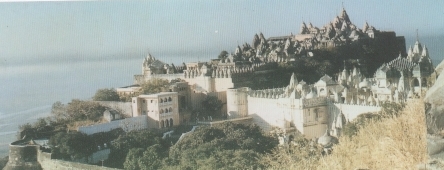
Palitana is located in Gujarat, 51 km south west of Bhavnagar. The town has a good road and rail network that connects it to the other cities of Gujarat. Bhavnagar, the nearest airport lies at a distance of 60 kilometer from Palitana. Siddha Kshetra Shri Shatrunjaya Teerth is situated on a hill, which is decorated by 3500 temples. Spires of the temples attract pilgrims from a far distance. Nagarjuna founded Palitana, which derives its name from Guru Padalipta or politta. The chief attraction here is the holy Jain shrine Shatrunjay Hill, 3 km away from the railway station.

On the top of the hill 873 temples were built of white marble, the work beginning in the 11th century and continuing for 900 long' years. However, destroyed by the Muslim invasions in 14th and 15th centuries, the temples were built anew in 1500. They are unique- in their architecture and sculpture. The ornamented temples look like ivory miniatures in the sunlight, seems to be wedding cake. Notable among the temples are Adinath, Kumarpal, Sampriti Raj, Bimal Shah. The holiest temple among the cluster, according to the Jain pilgrims, is the temple of Adishwar, the first Jain Tirthankar. It is also the most beautifully wrought. The marble image of the deity is bedecked with gold ornaments studded with precious jewels. The largest temple built in 1618 is that of 4-faced Adinath, the first Tirthankara.


Bhagawan AdishvarJain Teerth:

Steps :- 3364
Height:- 2000 ft
mile:- 7.5
Idols :- 27007
Jain Mandir :- 3507
Pagla:- 1500

It is on the Shetrunjaya Mountain at a distance of nearly six kilometers near the city of the bank of the river Shetrunjaya.

The artistry and sculpture of these temples aptly illustrate the ancient art.
Historical Details: This tirth is known as the eternal tirth. The ancient name of the city of Palitana was Padliptapur. In olden times this mountain was also called Pundarikgiri. Palitana is a city of temples.


The temple was renovated 16 times as under.
First Renovation : By Chakravarti Bharat, the son of Bhagawan Adinath.
Second Renovation : By the King named Dandavirya.
Third Renovation : By Shri Ishaneshvar in the interim period between the times of the first and the second Tirthankaras.
Fourth Renovation : By Mahendra of the fourth upper world (dev-loko).
Fifth Renovation : By Brahmendra of the fifth upper world.
Sixth Renovation : By Chamarendra, Indra of Bhavanapatis.
Seventh Renovation : By Sagar Chakravarti, the second Chakravarti of the times of Bhagawan Ajitnath. Eighth Renovation : By Vyantarendra in the times of Abhinandan Swami.
Ninth Renovation : By King Chandrayasha in the times of Chandraprabh Swami.
Tenth Renovation: By Chakradhar, the son of Bhagawan Shantinath in the times of Bhagawan Shantinath. Eleventh Renovation : By Ramchandraji and Lakshamanji in the times of Munisuvrat Swami.
Twelfth Renovation : By the five Pandavas in the times of Bhagawan Neminathji.
 Thirteenth Renovation : By Sheth Javed Shah of Mahuva in the year 108 of the Vikram era. He spent a million gold mohurs.
Fourteenth Renovation : By the advisor Bahud in the times of Kumarpal in the year 1213 of the Vikram era. Fifteenth Renovation : By Shri Samara Shah in the year 1371 of the Vikram era.
Sixteenth Renovation : By Shri Karama Shah of Chitod on the auspicious sixth day of the dark half of the month of Vaishakh in the year 1587 of the Vikram era.

Managing Trust:
Shri Anandji Kalyanji Pedhi Management
:Shri Anandji Kalyanji Pedhi, Taleti Road, Palitana- 364270. Dist Bhavnagar, Gujarat
Trust: -Shree Digambar Jain Siddhaksetra Sathrunjaya ji, P.O-Palitana, District-Bhavnagar, Gujrat Pin-364270
Trust:- Shree Palitana Desha Humad Digambar Jain Mandir Trust,
Phone: -02848-252547
Boarding Lodging in Dharamshala in the city near Mandvi.

Picture of Palitana jian tirth

Thursday, 29 December 2011

Chidambaram Temple


Chidambaram Temple is about 200 kilometers south of Chennai in Tamil Nadu, South India. Nataraja temple is located in the centre of the town of Chidambaram and covers an area of 40 acres.


It is one of the ancient temples of Tamil Nadu. The roof of the sanctum sanctrorum is covered with gold plates. The Eastern tower rises to a height of 40.8 metres. 108 Bharatha Natyam Dance gesture can be seen on the Eastern tower as well as on Western tower. The Northern tower rises to height of 42.4 metres.The Sivakamiamman temple, the Sivaganga tank, the thousand pillar hall are other important features of the Temple.

Chidambaram is associated with Nataraja, or Shiva in his Ananda Tandava pose (the Cosmic Dance of bliss) in the cosmic golden hall and the hall of consciousness (Chit Sabha). The word "Koyil" or temple in the Tamil Saivaite tradition refers to none other than the Chidambaram Nataraja temple.

Chidambaram is one of the Panchabhoota Stalams signifying the five elements of wind (Kalahasti), water (Tiruvanaikka), fire (Tiruvannamalai), earth (Kanchipuram) and space (Chidambaram).

Four most revered Saivaite Saints (Appar, Sundarar, Sambandar and Manikkavachakar) have worshipped at Chidambaram, and the bulk of Manikkavachakar's work is in praise of Shiva at Chidambaram. Accordingly, their images are placed in the temple entrances corresponding to their points of entry into the temple. (Sambandar - South, Appar - West, Sundarar - North and Manikkavachakar - East).

This temple is home to Chidambara Rahasyam, concept of nothingness (aroopam). Shiva is said to have revealed a vision of his cosmic dance to Patanjali, Vyagrapadar and to all the Devas here. In terms of its antiquity, richness in terms of worship & festival traditions, in architectural & sculptural splendour, in its association with music & dance, Chidambaram is a center second to none in truly representing the rich Indian cultural heritage.

PLACES OF INTEREST

Kali Temple: The Thillaikaliamman temple is on the northern end of the town. It was built by Kopperunjingan, who ruled between 1229 AD and 1278 AD.

Annamalai University: It is a residential University founded by the Raja Sir Annamalai Chettiar. It is a great centre of Tamil learning and carnatic music; now offers educational facilities in various disciplines including Medicine, Agriculture, Engineering etc.

Pichavaram: Pichavaram, 16 kms. east of Chidambaram, ranks among the most exquisite scenic spot with abundant and varied tourism resources. The backwaters which are interconnected by the Vellar and Kollidam system offer abundant scope for water sports - parasailing, rowing and canoeing.

Neyveli: It is about 30 kms. from Chidambaram via Vadalur. It is one of the biggest industrial complexes in the country. The lignite mined here is used for thermal power generation. Apart from fertilisers ceramic wares and Leco (cooking coal), a number of by-products are also produced from lignite.

Kalvarayan Hills: The Kalvarayan hills are situated 150 kms north west of Chidambaram on the western side of Kallakurichi Taluk. Spread over an area of 600 sq. kms. approximately with the height ranging from 315 mts. to 1190 mts. these hills offer a temperate climate and quiet solititude. There is a botanical garden on the hills. There are two waterfalls here. The area is ideal for trekking. A summer Festival is also held every year in May.

Tarangambadi: Once the site of a Danish settlement, Tarangambadi has the remains of the Dansborg fort built by Ore Gedde, the commander of the Royal Dutch Navy, in the 17th century. The fort constructed in 1620 with two storeys was the most important building which housed the top echelons of the Danish officials. Apart from the ramparts, the rest of the buildings are in good condition.

Arunachaleswara Temple in Tiruvannamalai is dedicated to Lord Siva


Arunachaleswara Temple in Tiruvannamalai is dedicated to Lord Siva and it is one of the largest temples in India . Arunachaleswara temple is one of the "Panch Boodha Sthalams" and it is "Agni" Sthalam. It has also the importance as "Padal Petra Sthalam". That is the four famous 'Saiva Saints and Poets' such Appar, Sundarar, Manichkavasakar and Thirugnana Sambandar made several poems on Lord Arunachaleswara.
Tiruvannamalai is one of the greatest Saivite shrines in India, on a sprawling 24 acre temple campus, drawing hundreds of thousands of pilgrims every full moon. The hill here is considered to be a manifestation of Shiva. Tiruvannamalai is one of the Panchabhoota Stalams signifying the 5 elements of wind (Kalahasti), water (Tiruvanaikka), fire (Tiruvannamalai), earth (Kanchipuram) and space (Chidambaram). Kartikai Deepam festival here is of great significance. Manikkavacakar composed his Tiruvempavai here.The Paatala Linga shrine is connected with the spritual savant Ramana Maharishi. Arunagiri Nathar began composing his Tiruppukazh here at this temple. 


Legend here goes that Shiva assumed the form of a huge column of fire, whose origins Bhramma and Vishnu failed to trace.
When we observe the general structure of the temple, we notice that there are five small gopurams on the inner boundary and four big gopurams on the outer boundary. The inner gopurams are known as Kitti gopurams. There are two gopurams in the East and one gopuram each for the other three directions. The first of the two Eastern gopurams is called Kili gopuram. There are indications that this was built in the 11th century. The gopurams built during this period have no more than five stories. The Kili gopuram was built by Veera Rajendra Chozhan around 1063 A.D. He is referred to as Maharaja Thiribuvana Chakravarthigal in the inscription.This name was also given to the gopuram. The Kitti (smaller) gopurams, except the top of the western one, were built by the Hoysala King Vallala Maharaja III. His name is given to the biggest Kitti gopuram which is in the East.
In the outer gopurams, historians say the western gopuram is the oldest. The base was built by Vallala Maharaja. The top belongs to a later style. Inscriptions attribute this to Krishna Deva Raya of Vijayanagar. This king had undertaken important construction work in this temple. It is said, he built the base of the other three gopurams. But the architectural style of the base of the Western gopuram was constructed first and then those of the South, East and North. Though the Eastern gopuram, known as the Rajagopuram looks older, it was built after the Western one. This was constructed by Krishna Deva Raya and renovated by king Sevappa Naicker of Tanjore. There is another view that this was completely built by Sevappa Naicker. Tamil and Sanskrit inscriptions on the Western gopuram dated 1690 A.D. bear witness to this. Krishna Deva Rayer of Vijayanagar also constructed the hundred pillared and thousand pillared halls in the temple. He dug the Sivagangai Thirtham in front of the thousand pillared hall. As mentioned earlier, he built the base of the three gopurams and either began or finished the Eastern Rajagopuram with eleven stories. 

All the kings mentioned above and chieftains like Kadava Raya, Sambuvaraya and Banas expressed their devotion to Arunachaleswara by building small temples inside the Arunachaleswara temple as well as around the mountain and elsewhere in the town. These kings were also responsible for digging many ponds in this region. To the devotees visiting the town and the temple, its architectural splendor and sculptured beauty, its rich lands and ponds, its jewels and appurtenances, the inscriptions and the wealth of literature praising the glory of Arunachaleswara are glowing evidence of the love that the lord has commanded in the minds of kings and commoners through the centuries. Critics may take exception to the absence of continuity in the architectural style but there is no lack of continuity in the depth of piety of the kings who built it. 

Click here for more detail

Tuesday, 27 December 2011

SiddhiVinayak temple at Prabhadevi in Mumbai

<div class="separator" style="clear: both; text-align: center;">
<a href="http://3.bp.blogspot.com/-Xl-YIg0Z5LY/TvltvLkDlmI/AAAAAAAAAFU/VelkFGO9-pY/s1600/siddhivinayak-temple.jpg" imageanchor="1" style="margin-left: 1em; margin-right: 1em;"><img border="0" height="255" src="http://3.bp.blogspot.com/-Xl-YIg0Z5LY/TvltvLkDlmI/AAAAAAAAAFU/VelkFGO9-pY/s320/siddhivinayak-temple.jpg" width="320" /></a></div>
<div style="color: black; font-family: inherit;">

</div>
<div style="color: black; font-family: inherit;">

</div>
<div style="color: black; font-family: inherit;">
The temple was first consecrated on  Thursday 19'h November 1801. The idol made of black stone was placed in  a small structure; the existing temple was rebuilt on the site of a  200-year old temple. The narrow lane outside the temple is the 'Phool  galli' lined with innumerable stalls selling tulsi flower garlands,  coconuts, an array of sweets including the pear shaped favourite yellow  sweet of Lord Ganesha, the 'modak', and a range of religious  paraphernalia.&nbsp;</div>
<div style="color: black; font-family: inherit;">

</div>
<div class="separator" style="clear: both; text-align: center;">
<a href="http://4.bp.blogspot.com/-temHcZ1-q2s/TvltDlvpZHI/AAAAAAAAAE8/WIFSonjosZw/s1600/Siddhivinayak-Temple-Mumbai.jpg" imageanchor="1" style="margin-left: 1em; margin-right: 1em;"><img border="0" height="244" src="http://4.bp.blogspot.com/-temHcZ1-q2s/TvltDlvpZHI/AAAAAAAAAE8/WIFSonjosZw/s320/Siddhivinayak-Temple-Mumbai.jpg" width="320" /></a></div>
<div style="color: black; font-family: inherit;">

</div>

SiddhiVinayak temple at  Prabhadevi in Mumbai. This Vinayak temple in Mumbai is one of the oldest  temples of the city. On Tuesdays, the serpentine queue of worshippers  is almost over 2kms long. There are a lot of pujas performed in the  temple, as the lord here is believed to remove obstacles in every ones  way. Sankata Chathurhi, and Ganesh Chathurthi are celebrated with a lot  of pomp here. An estimated 1.5-to 2-lakh people visit this temple every  Tuesday.


The sanctum here houses a small mandapam enshrining Siddhi Vinayak. The  inner roof of the sanctum is plated with gold, and the wooden doors to  the sanctum are carved with images of Ashta Vinayak.
The idol of Ganpati has four arms therefore He is also called  Chaturbhuj. A lotus is held in the upper right hand and a small axe in  the upper left, holy beads are held in the lower right and a bowl full  of Modaks (a delicacy which is a perennial favorite with Sri  Siddhivinayak) in the lower left. Flanking the deity on both sides are  Riddhi and Siddhi, goddesses signifying sanctity, fulfilment, prosperity  and riches. On the forehead of the deity there is an eye, which  resembles the third eye of Lord Shiva. Most icons of Ganapati depict the  elephant faced God with his trunk curled towards his left. Siddhi  Vinayak in Mumbai, Siddhi Vinayak at Siddhatek in Maharashtra as well as  Karpaka Vinayakar at Pillayarpatti in Tamilnadu are depicted with a  trunk pointing to the right (Valampuri).

The temple as it stands now was re-constructed five years ago after  deliberations with experts on Hindu religion and customs, so as to  maintain the sanctity of the idol as per the Hindu Shastras. The temple  has a Kalash, which is a pointed dome of 12 feet high Gabhara (sanctum  sanctorum) weighing 1500Kgs and plated in gold. The Kalash, which  adorned the earlier temple was lowered with proper rituals and is kept  as an exhibit within the temple premises. The devotees earn the  satisfaction of seeking the blessing of The Lord by taking a devoted  look at the Kalash. The idol has not been touched in the process of  rebuilding the temple, so as to ensure that there is no human  transgression in the area from the point at which the idol is situated.  The Gabhara of the new temple structure has been designed with an aim to  attain maximum convenience and comfort for the devotees. It is a  spacious enclosure with 3 main doors of about 13 feet height. This  facilitates the 'Darshan' of Sri Siddhivinayak from either the area  surrounding the Gabhara or the stage (Sabha Mandap) constructed to  conduct pujas and festivities.

The area surrounding the Gabhara has been  designed as a sitting area and the stage adjoining the same is utilised  as a platform for common Darshan sought by the devotees who are unable  to spend hours in serpentine queues to go inside the Gabhara. It is an  octagonal enclosure, about 10 feet wide consisting of a silver plated  Makhar (a smaller structure within the Gabhara housing the idol of The  Lord). The dome inside the Gabhara is gold plated - designed to enhance  the beauty of the idol. An exquisite chandelier lights up the Gabhara,  making it a sight never to be forgotten. The three main doors, which are  used for entry and exit by the devotees, are made of perforated wood,  depicting Ashta Ganapati, Ashta Laxmi and Dashavatar.  

Monday, 26 December 2011

Amarnath Cave Temple

amarnath cave temple of lord shiva in jammu & kashmir, india
Amarnath Temple is a highly revered Cave Temple dedicated to Lord Shiva situated around 141 km from Srinagar in Jammu and Kashmir, India. Situated at an altitude of 3,888 m above the sea level, the Amarnath Caves stand at the end of Lidder Valley. The main Amarnath Cave Temple is the abode of Lord Shiva who is formed naturally of an ice – stalagmite. This Lingam is believed to grow and disappear with the phases of the moon. As such, the lingam excels on the full moon day and slowly diminishes and disappears on the new moon day. According to Hindu mythology, Amarnath is the cave used by Lord Shiva to explain the secret of life and eternity to his divine consort Goddess Parvati Devi. On the left side of the Shivling is an ice formation of Lord Ganesha and on the right are ice formations of Parvati and Bhairava.

Amarnath Yatra – Pilgrimage to Amarnath Temple 

Amarnath Yatra is an important pilgrimage for Hindus. According to Hindu belief, the Amarnath Cave Temple Yatra begins on Ashadha Purnima (Full Moon day in the month of Ashadha) and ends on Shravana Purnima (Full Moon day in the Hindu month of Shravana). That is, the annual yatra is performed during July and August. This year, the Amarnath Yatra 2011 begins on 29th June 2011 and concludes on 13th August 2011 on Raksha Bandhan festival day.

Amarnath Pilgrimage Journey

The pilgrimage generally starts from the 42 km travel on foot from the town of Pahalgam, (about 96 km from Srinagar) and lasts for four to five days. The traditional trek route is Pahalgam – Chandanwari – Pissu Top – Sheshnag – Panchtarni – Amarnath Cave. The Amarnath Cave is reached on the full moon day and the pilgrimage is complete. Another route is the shorter route from the town of Baltal.

About 400,000 people visit the Amarnath Cave Temple, during the 45 days Amarnath Yatra pilgrimage season.

History of Amarnath Temple

Amarnath Cave Temple is believed to be of 5,000 years old. Legend says that a Muslim shepherd named Buta Malik discovered this Holy Cave. He was given a bag full of coal by a saint. The shepherd went home and opened the bag. He found that the bag was full of gold coins which made him happy. He went back to thank the Saint. But he found that the Saint had disappeared and noticed The Holy Cave. Thereafter this has become the holy place of pilgrimage.

Another legend about Amarnath Cave Temple says that the valley of Kashmir was beneath water and it was the sage Kashyap who drained the water through rivers and rivulets. Bhrigu Rishi who was on his way to The Himalyas was the first person to have found this Holy Cave and the Lingam.


Amarnath cave temple of amarnath yatra pilgrimage in Jammu, india

According to Hindu Myth, Lord Shiva was looking for a secret isolated place to tell the "Amar Katha" to Goddess Parvathi and thus he selected the Amarnath Cave. He left his vehicle Nandi, the celestial bull, in Pahalgam, released the moon from his hair at Chandanwari and on the banks of Lake Sheshnag, he released the snakes. He left his son, Lord Ganesh, at Mahagunas Parvat and at Panjitarni, he left Five Elements of life - earth, water, air, fire and sky. At last he created Rudra named Kalagni and ordered him to fire up and remove every living thing in and around the holy cave. Then the Lord took Goddess Parvathi inside the cave to narrate the Amar Katha.

How to reach Amarnath Temple 

By Air

The nearest airport is at Srinagar, around 141 km away from Amarnath Temple.

Jammu (300 km) serves as the nearest railhead and bus station. Jammu and Srinagar are connected through road services.

By Train / Bus

Jammu (300 km) serves as the nearest railhead and bus station. Jammu and Srinagar are connected through road services.