Pawapuri was at this place that Lord Mahavira, the twenty fourth Tirthankar attained “Nirvana” or eternal salvation from the cycle of death and birth in the year 527 BC. The Pictures shows the “Charan Paduka” housed in Jal Mandir, one of the 5 main temples in Pawapuri. It marks the spot where the mortal remains of the Lord Mahavira was creamated.
Pawapuri is situated in Bihar, India and its proximity to the capital city, Patna makes it approachable to pilgrims and tourists alike. It is situated on the Patna-Ranchi road and can be approached either from Nawadah or Bihar Sharif.
During ancient times about 2600 year ago, Pawapuri was the part of Magadha Kingdom and was called “Madyama Pawa” or “Apawapuri”, Ajatshatru, the son of King Shrenik who was one of the greatest disciples of Lord Mahavira was the King of Magadh during the lifetime of Mahavir. During the reign of Ajatshatru King Hastipal was the King of Pawapuri. When Lord Mahavira came to Pawapuri he stayed in King Hastipal’s “Rajikshala”.
There are five main temples in Pawapuri – the Jal Mandir,the Gaon Mandir,the Samosaran,the New Samosaran and another temple built by Bibi Mehetab Kumari. Apart from these temples there is a Digamber Mandir near Jal mandir.
jal-mandir-featured
Jal mandir as the name suggests is a temple in the middle of a lake blooming with lotuses. The main deity of the beautiful temple is a very old “Charan Paduka” of Lord Mahavira. It marks the spot where the mortal remains of Lord Mahavira was cremated. It is believed that this temple was built by King Nandivardhan, elder brother of Lord Mahavira.
Jal Mandir is built in the shape of “Vimana” and there is a stone bridge about 600 feet in length across it from the bank to the temple.
According to the legend, the concourse of the people who attended the funeral ceremony of Lord Mahavira , was so large that the mere act of their taking a pinch of ashes created such a big hollow over the place that it transformed into present tank.
The sheer beauty , along with the peace and tranquility of this temple is a treat to the eyes of the visitors.
DSC00248
The Gaon mandir or the village temple marks the spot where Lord Mahavira breathed his last. It is said that this temple was built by King Nandivardhan, elder brother of Lord Mahavira. It is at this spot where the Lord addressed his last preachings our “updesha” . This “updesha” was supposed to be attended by many people, from across the country and from different walks of life. Knowing that his end was not far, Mahavira started his last “updesha” . He continued to preach till he gained “Nirvana” . Unable to bear the loss of the Lord all the people present there illuminated “diyas” (lamps) fuelled by ghee to lighten the atmosphere of sorrow. This tradition has continued till day.
Gaon mandir has a big compound along with a huge Dharamshala with all the neccessary basic amneties catering to the comfort of the pilgrims. The dedicatory stone of the temple records the restoration of Pawapuri during the reign of Emperor Shah Jahan in 1641 AD by Swetamabri Sangh of Bihar under Acharya Jina RajaSuri
Click here for more detail
Showing posts with label Jain Temple. Show all posts
Saturday, 17 March 2012
Pawapuri Jal Mandir of Mahavir Swami
Wednesday, 7 March 2012
Sametshikhar Shikharji Parasnath Hill
Shikharji or Sametshikhar also known as the Parasnath Hill, located in Giridih district in Jharkhand, India, is a major Jain pilgrimage destination and is the most sacred place for Jains in the world. According to Jain belief, twenty of the twenty-four Tirthankaras (teachers of the Jains) attained Moksha (Nirvana) from this place. Parasnath Hill with a height of 1,350 metres (4,430 ft)) make up the highest mountain in the state of Jharkhand.
Shri Sammed Shikharji attracts pilgrims from across India.
The number of Tirthankars who attained nirvana at Shri Sammet Shikharji is 20. For each of them there is a shrine on the hill.
The hill is also known as Parasnath, a name derived from Parshva, the 23rd Tirthankara who attained Nirvana there. His present temple is not very old, although the idol in the main temple is ancient. The Sanskrit inscriptions at the foot of the images indicate that they were put in the temple in 1678 A.D.
Archaeologists believe some of the existing temple edifices on Parasnath Hill date from 1765 A.D. although the place is of greater antiquity. It is certain that the present edifices replace older edifices, which were demolished. Jain temples are often pulled down and re-built.
Each tirtha (pilgrimage site) represents centuries of devotion, which found expression in temple-building, and to this day are at the centre of pilgrimages and festivals at frequent intervals. Although many of the temples may seem complicated in appearance, each is designed on the principles common to the religious architecture of the late medieval period, the elaborations being due to such factors as the addition of supplementary shrines, second stories, and adding pillared cloisters around all the larger examples. One variation unique to Jain temples is the frequent production of a class of temple known as chaumukh, or four-faced.
There is a Temple of Bhomiyaji at the start of the Hills (Termed as Taleti) and it is said that once you bow your head at this temple and start the journey towards the top of the hill, there is no way you can be mislead in the journey. The moment you forget the way, there will be Dogs who will guide you the way and will soon disappear fast once you are back on track.
Tirthankaras attaining Nirvana at Shri Sammed Shikharji
Shri Ajitnath Ji
Shri Sambhavanath Ji
Shri Abhinandannath Ji
Shri Sumatinath Ji
Shri Padmaprabha Ji
Shri Suparshvanath Ji
Shri Chandraprabha Ji
Shri Suvidhinath Ji
Shri Sheetalnath Ji
Shri Shreyansanath Ji
Shri Vimalnath Ji
Shri Anantnath Ji
Shri Dharmanath Ji
Shri Shantinath Ji
Shri Kunthunath Ji
Shri Aranath Ji
Shri Mallinath Ji
Shri Munisuvrata Ji
Shri Naminatha ji
Shri Parshva Ji
One can also pay a visit to Palganj Ji, which is just 12 km away from Madhuban (place from where this journey begins). This temple has a sculpture of Shri Parasnath Bhagwan which was from 4th Century, also the priest of the temple narrates story about this temple which is worth to listen.
Shikharji temples
Following are temples at Shikharji. The actual temples are not numbered; hence there may be minor differences in the numbering of temples in various guidebooks and literature. The following numbering is based on the guidance provided by the local Shikharji resident supervisor.
Shri Gautam Swami (Ghandhar)
Shri Kunthunath Prabhu (17th Tirthankar)
Shashvat Jin Shri Rishbhanan Prabhu
Shashvat Jin Chandranan Prahbu
Shri Naminath Prabhu (21st Tirthankar)
Shri Arnath Prahbu (18th Tirthankar)
Shri Mallinath Prabhu (19th Tirthankar)
Shri Shreyansnath Prabhu (11th Tirthankar)
Shri Suvidhinath Prabhu (9th Tirthankar)
Shri Padam Prabhu (6th Tirthankar)
Shri Munisuvrat Prabhu (20th Tirthankar)
Shri Chandrah Prabhu (8th Tirthankar)
Shri Adinath Prabhu (1st Tirthankar)
Shri Anantnath Prabhu (14th Tirthankar)
Shri Sheetalnath Prabhu (10th Tirthankar)
Shri Sambhavnath Prabhu ( 3rd Tirthankar)
Shri Vasupujya Prabhu (12th Tirthankar)
Shri Abhinandan Prabhu ( 4th Tirthankar)
Shri Shubh Swami Ghandhar
Jal Mandir
Shri Dharamnath Prabhu (15th Tirthankar)
ShashvatJin Shri Vardhman Prabhu
ShashvatJin Shri Varishen Prabhu
Shri Sumatinath Prabhu (5th Tirthankar)
Shri Shantinath Prabhu (16th Tirthankar)
Shri Mahavir Prabhu (24th Tirthankar)
Shri SuParshavnath Prabhu (7th Tirthankar)
Shri Vimalnath Prabhu (13th Tirthankar)
Shri Ajitnath Prabhu (2nd Tirthankar)
Shri Neminath Prabhu (22nd Tirthankar)
Shri Parshavnath Prabhu (23rd Tirthankar)
click here for more detail
Palitana Shatrunjaya Giriraj
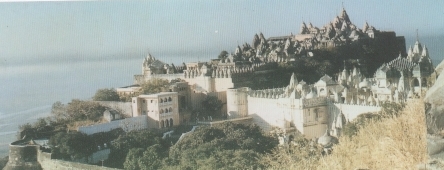
Palitana is located in Gujarat, 51 km south west of Bhavnagar. The town has a good road and rail network that connects it to the other cities of Gujarat. Bhavnagar, the nearest airport lies at a distance of 60 kilometer from Palitana. Siddha Kshetra Shri Shatrunjaya Teerth is situated on a hill, which is decorated by 3500 temples. Spires of the temples attract pilgrims from a far distance. Nagarjuna founded Palitana, which derives its name from Guru Padalipta or politta. The chief attraction here is the holy Jain shrine Shatrunjay Hill, 3 km away from the railway station.
On the top of the hill 873 temples were built of white marble, the work beginning in the 11th century and continuing for 900 long' years. However, destroyed by the Muslim invasions in 14th and 15th centuries, the temples were built anew in 1500. They are unique- in their architecture and sculpture. The ornamented temples look like ivory miniatures in the sunlight, seems to be wedding cake. Notable among the temples are Adinath, Kumarpal, Sampriti Raj, Bimal Shah. The holiest temple among the cluster, according to the Jain pilgrims, is the temple of Adishwar, the first Jain Tirthankar. It is also the most beautifully wrought. The marble image of the deity is bedecked with gold ornaments studded with precious jewels. The largest temple built in 1618 is that of 4-faced Adinath, the first Tirthankara.
Bhagawan AdishvarJain Teerth:
Steps :- 3364
Height:- 2000 ft
mile:- 7.5
Idols :- 27007
Jain Mandir :- 3507
Pagla:- 1500
It is on the Shetrunjaya Mountain at a distance of nearly six kilometers near the city of the bank of the river Shetrunjaya.
The artistry and sculpture of these temples aptly illustrate the ancient art.
Historical Details: This tirth is known as the eternal tirth. The ancient name of the city of Palitana was Padliptapur. In olden times this mountain was also called Pundarikgiri. Palitana is a city of temples.
The temple was renovated 16 times as under.
First Renovation : By Chakravarti Bharat, the son of Bhagawan Adinath.
Second Renovation : By the King named Dandavirya.
Third Renovation : By Shri Ishaneshvar in the interim period between the times of the first and the second Tirthankaras.
Fourth Renovation : By Mahendra of the fourth upper world (dev-loko).
Fifth Renovation : By Brahmendra of the fifth upper world.
Sixth Renovation : By Chamarendra, Indra of Bhavanapatis.
Seventh Renovation : By Sagar Chakravarti, the second Chakravarti of the times of Bhagawan Ajitnath. Eighth Renovation : By Vyantarendra in the times of Abhinandan Swami.
Ninth Renovation : By King Chandrayasha in the times of Chandraprabh Swami.
Tenth Renovation: By Chakradhar, the son of Bhagawan Shantinath in the times of Bhagawan Shantinath. Eleventh Renovation : By Ramchandraji and Lakshamanji in the times of Munisuvrat Swami.
Twelfth Renovation : By the five Pandavas in the times of Bhagawan Neminathji.
Thirteenth Renovation : By Sheth Javed Shah of Mahuva in the year 108 of the Vikram era. He spent a million gold mohurs.
Fourteenth Renovation : By the advisor Bahud in the times of Kumarpal in the year 1213 of the Vikram era. Fifteenth Renovation : By Shri Samara Shah in the year 1371 of the Vikram era.
Sixteenth Renovation : By Shri Karama Shah of Chitod on the auspicious sixth day of the dark half of the month of Vaishakh in the year 1587 of the Vikram era.
Managing Trust:
Shri Anandji Kalyanji Pedhi Management
:Shri Anandji Kalyanji Pedhi, Taleti Road, Palitana- 364270. Dist Bhavnagar, Gujarat
Trust: -Shree Digambar Jain Siddhaksetra Sathrunjaya ji, P.O-Palitana, District-Bhavnagar, Gujrat Pin-364270
Trust:- Shree Palitana Desha Humad Digambar Jain Mandir Trust,
Phone: -02848-252547
Boarding Lodging in Dharamshala in the city near Mandvi.
Picture of Palitana jian tirth
Subscribe to:
Posts (Atom)