Monday, 8 August 2011
Ekaveera Devi
Shri Manasa Devi

Shri Manasa Devi: Shri Manasa devi is considered as the Serpent Goddess or the Queen of Serpent Gods. She was the daughter of Kasyapa muni and Kadru, the sister of the serpent King Sesha. She is also considered as the goddess of fertility. Some people say that she is a pre-Aryan goddess. She is is worshipped mostly in the eastern parts of India.
Shri Manasa devi is associated with earth and higher knowledge of nature. She is said to have special powers that can fulfill the wishes of her devotees and protects them against snakebite. She cures infectious diseases and showers the devotee with wealth and prosperity. She is worshiped with rituals and sacrifices in the rainy season, as this is the time when snakes are most active in this season.
Wednesday, 22 December 2010
Aranyani Devi
Aranyani has the distinction of having one of the most descriptive hymns in the Rhg Ved dedicated to her. She is described as elusive, fond of quiet glades in the jungle, and fearless of remote places. Indeed the supplicant entreats her to explain, how she wanders, so far from the fringe of civilisation, without becoming afraid or lonely. She is adorned with anklets of bells and is seldom seen but more often heard as the tinkling of her anklets echos through the dark forest. She is also described as a dancer. Her worship has declined in modern day Hinduism, and it is rare to find a temple dedicated to Aranyani.
Thursday, 3 June 2010
Kanyakumari Maa

Pratyangira Devi

Saturday, 29 May 2010
Shri Dev Vetoba Ajgoan

Shri Nagneshi Mataji
Sub-gotras:-
CHORADIA :- NABARIA, SHRAFF, KAMANI, DUDHONI, SIPANI, ASANI, SAHLOT, SODHANI, UDAK, LAGU-SODHANI, GASANIYA, DEDANI, MANIYAR, RAMPURIA, NAGOURI, POPANI, CHHADOT, MAMMAIYA, KHAJANCHI, SONI, HADERA, DAFTRI, TOLAVAT, RAO-JOHARI, GALANI, DHANANI, MOLANI, DEVSAYANI, NANI, SHRAVANI, BAKAD, MAKKAD, BHAKKAD, LUNTANKAD, SANSARIA, KOBERA, BHATARAKIA, PITALIYA, FALODIA, SANGHVI, BOHARA, CHAUDHARY, OSTWAL.
PARAKH :- BHAVSARA, LAGU-PARAKH, DHELADIA, JASANI, MALHANI, TRANDAK, TEJANI, RUPAVAT.
GOLECHHA :- DAULTANI, SANGANI, NAPADIA, KAJANI, KULA, MEHAJAVAT, NAGDA, CHITORA, DATARA, MINAGRA.
SHRAVANSUKHA(SAMSUKHA) :- MINARA, LOLA, BIJANI, KESARIA, BALA, NANDECHA,.
BHATNERA :- CHAUDHARY, KUMPAVAT, BHANDARI, JIMANIA, CHHEDAVAT, SAMBHARIA, KANUGA.
GADHAIYA :- GEHLOT, LUGAVAT, RANSHOBHA, BALOT, NOPTA.
BUCHCHA :- SONARA, BHANDALIA, KARMOT, DALIA, RATANPURA.
Above 92 gotras are sub gotras of Aadityanag gotra. The time of origin of these gotras is veer sawat, according to the history of Oswals, or as per Upkesh Gachh Patawali. The kuldevi is Jagat Bhawani Sanchayay Mata, but Khartar gachh yati ramlalji wrote in his book 'mahajan vansh muktawali' origin of this is
in V.S. 1192, and in its support he wrote a story
In V.S. 1192 Kharhatsingh Rathore was the ruler of Chanderi. He had 4 sons, named Ambdeo, Nimbdeo, Bhesashah, and Aaspal. Once Chanderi was looted by Mohammedan dacoits. All the four brothers followed the dacoits. Severe fight took place. Mohammedans could not face the Rathors, hence they were defeated and ran away living all the loot behind. Raja Kharhatsingh return the wealth to the owner, even then a lot of wealth remain behind. That fight was monetary that war was much more profitable but all the four brothers were wounded seriously. They were not cured even after many treatments.
By chance Acharya Jindutt Suri came in the city of Chendary. The Raja Kharhatsingh requested the Acharya to do some thing for the princes. Acharya poured some water on the princes and they all became well. The entire kingdom was over delighted. The royal family was so much impressed that they all adopted the Jainism and became Oswals.
One day the eldest prince handcuffed the thieves and came to the city so he and his family was named CHORADIA. Sohanraj Bhansali says that Kharhatsingh belonged to village Chordia so they were named Choradia. Yet today village Choradia is on Jodhpur - Jaisalmer road
SHANSUKHARAV :- Raja Kharhatsingh's third son Bheshashah had 5 sons. The eldest was Kunwarji. He was a famous astrologer. One day he announced in the Chitore Court that, that year there will be no rains in Shravan month but Bhadrwa will be green. When the same thing happened then the king of Chitore gave him the title of Shrvansukha.
Golechha or Golchha :- The second son of Bheshashah was Gelaji and his son was Bachhaji. The family of Bachhaji was named as Gelbachha and later on it became GOLCHHA.
PARAKH :- Bheshashah's fourth son was Passu. He was the best jeweler of his time. King Chandrasen of Ahad was so impressed with the intelligence of Passu that he appointed him his Minister. One-day jeweler came in the Chandrasen's court to sell a precious diamond. The diamond looked so precious and attractive so the king desired to purchase that but Passuji requested to have a look. Passuji immediately told that no doubt the diamond was precious but it has bad omens. On enquiring he replied that the family of the holder of the diamond would not prosperous, no female would remain alive. The Johari replied that he had not seen such a brilient Johari in his life; he was also selling such a precious diamond only because he had lost his wife as soon as he purchased that. The king was so impressed that he honored Passuji with the title PARAKH, and it became the gotra.
GADHAIYA :- The fifth son of Bheshashah was Senhath but pet name was Gadashah. So his family was named Gadhaiya or Gadia
BHATNERA-CHAUDHARY :- The second son of rah Kharhatsingh was Nimbdeo. He was the Judge (Chaudhary) of Bhatnera, so his family was named Bhatnera-Chaudhary.
BUCHHA :- Buchhashah was the third son of Bheshashah. So his family was named Buchha.
RAMPURIA :- The Chandravt princess of Rampur state married the king of Bikaner. At that time Alamchand choradia was appointed as the ambassador of Rampur, so family of Alamchand was named Rampuria.
GUGALIA :- A member of Kuwarji's family went to Jaisalmer and did the business of Gugal so his family was named Gugalia.
GULGULA :- Gulraj was a famous person in Kuwarji's family. He used to distribute Gulgula to the children so pubic named him Gulgula seth. Hence it became the gotra.
ASANI and OSTWAL :- The fourth son of Raja Kharhatsingh was Aaspal. Aaspal had two sons, Aasani & Ostwal and so their family was named Aasani and Ostwal.
In this way all the other sub gotras were named according to their parents name.
Friday, 7 May 2010
Maa Sati

Tuesday, 27 April 2010
Kheer Bhawani
Kheer Bhawani is a temple dedicated to the worship of the goddess Kheer Bhawani (originally just Bhawani) constructed over a sacred spring of hers in a natural setting. The worship of Kheer Bhawani is universal among the Hindus of Kashmir. The temple is situated at a distance of 14 miles east of Srinagar near the village of Tula Mula. The term kheer refers to the food used to propitiate the goddess, which became part of the name. As is the custom with Hindu deities, she has many names: Maharagya Devi, Ragnya Devi, Rajni, Ragnya Bhagwati, and so on.
Around the temple is an area covered with smooth and beautiful stones. In it are large, antique chinar trees beneath which the pilgrims sit or sleep on mats of grass. The colour of the spring changes. While most of the colours do not have any particular significance, the colour black is taken as an indication for inauspicious times for Kashmir. In 1886 Walter Lawrence, the British Settlement Commissioner for land, noted during his visit to the spring that its color was having a violet tinge.
History
Maharagya was pleased with the devotion of Ravana and appeared before him and Ravana got an image of the goddess installed in Sri Lanka. But the goddess became displeased with the vicious and licentious life of Ravana and so didn't want to stay in Sri Lanka. Therefore, under the command of the goddess, Hanuman got the image from Sri Lanka and installed it at the holy spot of Tula Mulla.
The mention of Kheer Bhawani is found in Kalhana's Rajtarangini. Kalhana writes that the sacred spring ofTula Mula is situated in a marshy ground. The name of the spring is Mata Ragini Kund.
Maharagini is the form of Durga Bhagvati. The Brahmins of Kashmir worship this spring and pilgrims from every comer of the country visit to have the darshan of the place.
In Rajtarangini Tula Mula is considered very sacred and the Brahmins of Tula Mula were very great and powerful. The spring of Maharagya was very sacred. Thousands of years ago many floods occurred in Kashmir and the sacred spring of Tula Mula also was inundated under its sway and the holy place could nowhere be traced. All around was water. At last Kashmir's Yogi Krishna Pandit had a dream in which the goddess appeared to him and ordered that she would swim in the form of a snake at the proper place and that he should stick large poles and when the water subsided there the holy spot was discovered. This event happened during the Samvat 4041.
The mention of this temple is also found in Abul-Fazal's book Aini-Akbari in which is written that the area of Tula Mula extended over the area of hundred bighas of land, which got sunk in the summer season and formed into a marsh.
Swami Rama Tirtha and Swami Vivekananda also visited here to have the darshan of the place.
Night view of the temple
With the pouring of milk and throwing of sugar candy in the spring by the pilgrims, a thick and solid layer was formed at its bottom. When it was cleared, the ruins of an old temple and shrine slabs engraved with figures were discovered. Here many images were also found but nobody rebuilt the temple till the Samvat 1969 when Maharaja Pratap Singh who was the disciple and worshiped this goddess, got a marvelous temple of marble made in the midst of the spring which shines like a pearl in a shell. The marble temple was completed in 1920s. Some people are of the opinion that there was a mulberry tree near holy spot of Kheer Bhawani which, in Kashmiri, is called Tul Mul. But Tul Mul is also derived from the Sanskrit phrase-Tul Muli-that is of great value. This means that all other pilgrim centres are of lesser value than this one. It is said that after Ravana finished the worship of the goddess he offered the kheer (rice pudding) to the goddess which she accepted and since then it is called Kheer Bhawani.
Friday, 22 January 2010
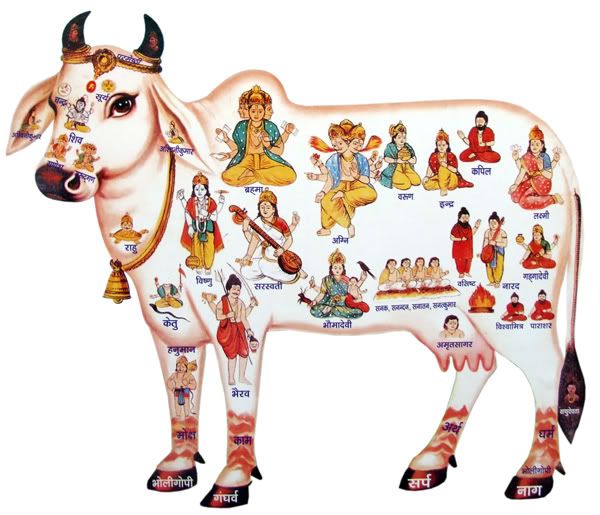
GAU-MATA

1) Two Horns of the Cow The Creator 'Brahma'
2) The Head of the Cow The Deity 'Indra'
3) Forehead of the Cow The Deity 'Agni
4) Collar of the Cow The Deity 'Yama'
5) Brain of the Cow The Deity 'Moon'
6) Upper Jaw of the Cow The Highest world Dyuloka
7) Lower Jaw of the Cow The Earth
8 The Tongue The Lightening
9) The Teeth The Deity 'Marut'
10) The Throat The 'Revatee' Constellation
11) The Shoulder The 'Kritka' Constellation
12) Bones of the Shoulder The Summer Season
13) All the Organs of the Cow The Deity 'Vaayu'
14) The Heaven The World to which cow, belongs
15) The BackBone The Deity 'Rudra'
16) In the Chest The Eagle
17) Is the Power & Strength Of the Cow The Space
18) Hunch of the Cow The Sage Vrihashpati
19) In the bones of the Chest The Stanza by the name of Vrihatee
20) The Back Angels & Fairies
21) Bones of the Ribs The Hostesses of the Angels & Fairies.
22) The Shoulders The Deity 'Varuna' and Friend
23) The Forelegs The Sage 'Tvashta & the sage 'Aryama'
24) The Hindlegs The Destroyer 'Lord Mahadeva'
25) The Backside of the Cow The wife of the Deity 'Indra'
26) The Tail The Deity 'Vaayu'
27) The Hairs of the Body The Sage 'Pawamana'
28) The Buttock The Caste 'Brahmin' & The caste'Kshatriya'
29) Lies in the Thighs The Strength of the Cow.
30) Bones of the Knees The Deity Sun and the Creator
31) The Calf of the Cow The Celestial Beings 'Gandharva'
32) In the Smaller Bones The Celestial Beings 'Apsara'
33) Hooves of the Cow The Mother of the Sun, God, 'Aditi'
34) In the Heart The Mind
35) In the Liver of the Cow The Intelligence
36) The Nerve By the Name Of 'Puritat' The Religious Vow 'Vrata'
37) The Belly The Hunger
38) In the Intestines Goddess Sarswati
39) In the internal part of the intestines The Mountains
40) In the Ovum The sorrow (Manyu)
41) In the sense Organs The Subjects & the People (Praja)
42) In the Ovary The River
43) In the Breasts The Deity 'Varuna'
44) In the cells of the Breasts which produce milk The Thundering clouds
45) In the Skin The 'All-Pervasive power'
46) In the hairs of the Body,Of the cow The Various Medicines
47) The Anus The heavenly & Celestial Beings 'Devagana'
48) In the Intestine The Man
49) In the Stomach The Celestial being 'Yaksha'
50) In the Kidney The Anger
51) In the Blood The Demon 'Rakshasha'
52) The Appearance of The Cow The Constellation are
53) In the Stomach The Other living beings
54) Is the Grossness The sky
55) In the Bone-Marrow The Death
56) Is Like Fire The Posture while sitting
57) Is the Deity 'Ashwinee Kumar The posture while getting up
58) The Deity 'Indra' The Posture while standing and facing East
59) The Lord of Death 'Yamaraja' The Posture while standing and facing South
60) The Creator 'Brahma' The Posture while standing and facing west
61) The Sun God The Posture while standing & facing North
62) The Deity Moon The Cow while Grazing
63) The Friend The Cow while looking
64) Pure Joy The Posture of the Cow while turning it back
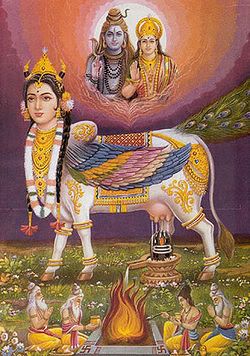
KAMADHENU MATA

KAMADHENU MATA
Thursday, 7 January 2010
Nandni Mata
Nandni Mata is also called Nandore Ma in the Vagadi language. According to ancient Hindu epics, Nandni Mata was a daughter of Yashoda in the Dwapad era, and was killed by Kansh. Mostly she is worshipped at the Navratri festival. Nandni Mata appears in several Vedic hymns and is also described in the eleventh chapter of the book Durga Saptmi. The hymn also associates her with Yashoda’s daughter .
Nandni Mata has been regarded as Pavagh Devi of Gujrat in Vagad. An Adivasi folk dance called "garba" is also devoted to Nandni Mata. She is equally revered by Hindus, Jains and the Buddhists in the Vagad.
Nandni Mata Temple is very famous in the Banswara district of Rajasthan. It is 15 km from Banswara, situated on the state highway near Barodiya town. The main temple is located on top of the hills near Barodiya village in Vagad. Many myths and rituals centre on the black stone statue here some centuries ago which was later destroyed by demolishers, and is now replaced by the new beautiful idol.
Wednesday, 30 December 2009
Maa Thawewali

The Goddess Maa "Shakti" is the "Supreme power" which saturates the entire of the universe, and from which the Universe has emanated. There is nothing in the world, which is not "Shakti" in its essence. Shakti is the Great Mother of the Universe. Maa fights and vanquishes the evil forces to protect her Bhaktas (Devotees). She is always on the lookout for ways and means of helping her Devotee. Maa is very "Karunamayi", "Kripalu" and "Dayalu" (Kindhearted).
There are several names and forms of Maa Shakti. Bhaktas (devotees) worship her by many names in many forms, Maa Thawewali is one of them. There are 52 "SHAKTIPITHAs" in all over India, this place is also as like as "SHAKTIPITHA".
The holy place of Maa Thawewali is situated in Thawe in Gopalganj District in Bihar, INDIA. Maa has arrived here from his another holy place Kamrup, Assam where she well known as "Maa Kamakhya", on the prayer of her great devotee "Shree Rahshu Bhagat". Maa also known as "Singhasini Devi". Thawewali Maa is very "dayalu" and "bhaktavatsal". No one has come empty handed from Maata temple. Maa has always answered the prayers of her devotees.
The time of Morning Aarti - between 5:00 to 7:00 am and in Evening 7:00 pm (depends on season). Devotees worship maa with "Laddo", "Peda", "Narial" & "Chunari".
Two days in week Monday and Friday are very important for worshiping to make pleased Maa. On these days Devotees gathered and worship Maa in large number in comparison to other days. The special Mela is organized during two times in year, in the month of "Chaitrya" (March) and "Ashvin" (October) on the great occasion of "Navratra".
Maa has given each one of her devotees what they deserve to get. Maa needs no expensive preparation from us. She needs few inexpensive and common things. Maa needs nothing from her devotees except few things like devotion (Bhakti), pureness (Pavitrata), and love. Greatness and miracles of Maa needs no description in words it is an invaluable experience of an individual who has to experience it in their own SHARDHA and BHAKTI.
This holy story pertains to about 14th century AD. King ‘Manan Singh’ from ‘Chero’ dynasty was ruler of ‘Hathuwa’. Although Manan Singh was a devotee of Maa Durga but he was having a proud nature. He claimed to be the greatest devotee of Maa Durga and did not like other saints and religious persons. People were not happy with the King due to his unkind nature and behavior.
The fort in which the king resided was located at present ‘Thawe’. One “Rahashu” lived in the same village who was a true devotee of ‘Maa Kamakhya’. People used to call him ‘Rahashu Bhagat’ to convey their respect to him.
Once there was a great famine in the state of Hathuwa. People started to die due to hunger. There was very bad condition everywhere, but the king continued to levy tax even in that miserable condition. Poor people became sadder due to the cruel attitude of the king. They did pray to “Maa Kamakhya” for relief. To relieve her devotees from their grief and pain, Maa Kamakhya appeared in midnight while sitting on seven lions and told to Rahashu Bhagat to cut ‘Katara’ (grass) and to worship her in midnight. Rahashu Bhagat used to cut ‘Katara’ (grass) whole day and yielded it in midenight by seven lions of Maa Kamakhya. Thus he got ‘Manasara’ (a type of holy Rice). Every morning Rahashu Bhagat distributed the Manasara among poor people. Rahashu Bhagat became very famous because he had relieved the poor people from their hunger.
When the king came to know about all these developments, he became very angry and called Rahashu Bhagat and insulted him. The king ordered Rahashu Bhagat to call Maa Kamakhya to prove his true devotion.
Rahashu Bhagat requested the king not to do so and suggested the King to pray the Maa with an honest heart but the king insisted to call Maa and threatened Rahashu Bhagat to kill in case of disobedience. At last, helpless Rahashu Bhagat started to pray Maa Kamakhya to call her. On the call from her true devotee, Maa Kamakhya started her journey sitting on seven lions from Kamrupa (Assam) where she is known as “Kamakhya Devi” to Thawe.
RahashuBhagat again requested the King to drop his insistence but the king did not agree and forced Rahashu Bhagat to call Maa. Meanwhile Maa appeared in Vindhyachal for sometime and was called Maa “VindhyavasniDevi”. In her way to Thawe Maa reached Kalighat in Calcutta and was called Maa “KalkaDevi”. Rahashu Bhagat again requested king to quit his wish and warned him for mass destruction but the king was not agreed.
In her way to Thawe Maa stayed at Patna for a while and was called “PatanDevi”. Then Maa appeared in “Aami” and “Ghodaghat” was called “AmbikaBhawanii” and “GhodDevi” respectively.
When Maa reached “Thawe” the weather and appearance of the place began to change. Due to hundreds of thunders King’s palace fell and destroyed. Everyone was feared. The devotees of Maa started to pray her to save them as they had known that Maa had reached Thawe.
After sometime, Maa appeared through broken head of RahashuBhagat and showed her right hand wearing a “Kanagan” (Bracelet). The four handed Maa appeared sitting on the seven lions and blessed her devotees. On the pray from her true devotees, Maa made the things normal and disappeared.
Maa Ganga

Ganga its origin at the source Gaumukh (the shape of the ice forming like a cow's mouth), gushing from the depths of Gangotri glacier. The Glacier is high and mighty at a height of4255 m above sea level and is approx 24 km in length and 7-8 km in width. It is known as Bhagirathi after King –Bhagirath in it’s initial phase of long journey. It emerges in the ice caves of Gangotri glacier and gushes down to join river 'Alaknanda' and becomes Ganga. The ancient holy scriptures are full of legends associated with river Ganga.
Father to 60,000 sons King Sagar defeated all the asuras (daemons) on the earth and planned to accomplish Ashwamedha Yagya to reinforce his supremacy. As was customary and prevalent in ancient times, he sent his horse across the earth accompanied by his sons toGods for their blessings. Frightened and insecure, The King of Heaven,
Lord Indra stole the horse and tied it to the ashram of Sage Kapil. Extremely livid and enraged seeing the horse in Chapel’s ashram, 60,000 sons attacked the sage’s hermitage. Sage Kapil’s deep meditation was broken and as he opened his eyes fuming in anger, the 60,000 sons of King Sagar were burnt to ashes, excluding the prince Asamanjas. Then Anshuman the grandson of King Sagar went to bring the horse back from the Sage and plead for his forgiveness. At that point sage Kapil suggested that the bringing back sons to life can happen only if Ganga is brought from heaven to earth. Neither Anshuman nor his son Dilip were could accomplish this feat. But Dilip's son, Bhagirath was resolute in his objective to get this mission accomplished. After intense meditation for several years he was able to please Ganga to descend to the earth. But to prevent the earth from flooding, Lord Shiva tied Ganga on his knotted locks. Only after years of worshipping by King Bhagirath; Lord Shiva blessed him and released seven streams Ganga from his locks. Ganga’s pure water reached and just as an elixir could achieve, it touched the Ashes of King Sagar’s son liberating them from death and sending them to heaven. The streams or distributaries Bhagirathi, Janhvi, Bhilangana, Mandakini, Rishiganga, Saraswati and Alaknanda amalgamate at Devprayag to form Ganga.
Bhagirath Shila, the rock on which King Bhagirath is supposed to have meditated, is located near the temple of Ganga. Even today it is widely believed that water of holy Ganga is believed to have Elixir (nectar) in it. Even scientists have concluded after research that the water from Ganga at its origin is in a pure state and remains uncontaminated even after being kept for several years on end. Secretions of herbs and mineral content from the Glacier which mix with the water, give Ganga Jal the medicinal properties which it is known for.
Wednesday, 23 December 2009
Radha Rani
Radha is often referred to as Rādhārānī or "Radhika" in speech, prefixed with the respectful term 'Srimati' by devout followers. Radha is one of the most important incarnations of Goddess Lakshmi.
In the story of Krishna, as told in the Mahabharata and the Bhagavata Purana, he spends much of his youth in the company of young cow-herd girls, called Gopis in the village of Vrindavan. The Mahabharata does not describe Krishna's earlier life in Vrindavan in much detail, and focuses more on the later battle of Kurukshetra but within the Bhagavata Purana the child-hood pastimes of Krishna are described very vividly. Within the Bhagavata Purana, Radha is not mentioned by name but is alluded to within the tenth chapter of the text as one of the gopis whom Krishna plays with during his upbringing as a young boy. Krishna left Vrindavan for Mathura at the age of 10 years and 7 months according to Bhagavata Purana. So Radha is assumed to be also 10 years old or less when Krishna left Vrindavan.
Vaishnava tradition states that Radha was born in either Barsana, or Rawal, a village about 8 kilometers from Vrindavan, near present day New Delhi in India. There are a number of accounts of her parentage. Her father was the king of cowherds called Vrsabhanu. Vrsabhanu was a partial incarnation of Lord Narayana while her mother Kalavati was a partial incarnation of Goddess Lakshmi.
Her worship is especially prominent in Vrindavan, the place where Krishna is said to have lived over 5000 years ago. Wherein Her importance surpasses even the importance of Krishna. Radha's love for Krishna is held within Gaudiya Vaishnavism as the most perfect primarily because of its endless and unconditional nature. Thus she is the most important friend of Krishna, 'His heart and soul', and His 'hladini-shakti' (mental companion potency).
In the Brihad-Gautamiya Tantra, Radharani is described as follows: "The transcendental goddess Srimati Radharani is the direct counterpart of Lord Sri Krishna. She is the central figure for all the goddesses of fortune. She possesses all the attractiveness to attract the all-attractive Personality of Godhead. She is the primeval internal potency of the Lord."
Sita Maa
Wednesday, 16 December 2009
Mira Bai
Mira Bai

Mirabai Mira is regarded as an incarnation of Radha. She was born in Samvat 1557 or 1499 A.D. in the village Kurkhi, near Merta, a small state in Marwar, Rajasthan. Mira was the daughter of Ratan Singh Ranthor and the grand-daughter of Dudaji of Merta. The Ranthors of Merta were great devotees of Vishnu. Mira Bai was brought up amidst Vaishnava influence, which moulded her life in the path of devotion towards Lord Krishna. She learnt to worship Sri Krishna from her childhood. When she was four years of age, she manifested religious tendencies. Once there was a marriage procession in front of her residence. The bridegroom was nicely dressed. Mira, who was only a child, saw the bridegroom and said to her mother innocently, "Dear mother, who is my bridegroom?". Mira’s mother smiled, and half in jest and half in earnest, pointed towards the image of Sri Krishna and said, "My dear Mira, Lord Krishna—this beautiful image—is your bridegroom".
Mirabai, or Mira Bai or Meerabai, was a 16th century princess whose life is known more through legend than verifiable historic fact. The following biography is an attempt to report those facts of Mirabai's life which are commonly accepted.
Mirabai's Rajputi grandfather, Rao Dudaj, created the fortress city of Merta, where Mirabai's father, Ratan Singh, ruled. Mirabai was born in Merta about 1498. The family worshipped Vishnu as their primary deity.
Her mother died when Mirabai was about four, and Mirabai was raised and educated by her grandparents. Music was stressed in her education.
At an early age, Mirabai became attached to an idol of Krishna, given to her (legend says) by a traveling beggar.
At age 13 or 18 (sources vary), Mirabai was married to a Ranjputi prince of Mewar. Her husband died only a few years later.
His family was shocked that, first, she did not commit sati, burning herself alive on her husband's funeral pyre, as was considered proper for a Rajputi princess (rani). Then they expected her to remain secluded as a widow, and to worship his family's deity, the goddess Durga or Kali.
Instead of following these traditional norms for a widowed Rajputi princess, Mirabai took up enthusiastic worship of Krishna as part of the Bhakti movement. She identified herself as the spouse of Krishna. Like many in the Bhakti movement, she ignored gender, class, caste, and religious boundaries, and spent time caring for the poor.
Mirabai's father and father-in-law were both killed as a result of a battle to turn away invading Muslims. Her practice of Bhakti worship horrified her in-laws and the new ruler of Mewar. The legends tell of multiple attempts on her life by Mirabai's late husband's family. In all of these attempts, she miraculously survived: a poisonous snake, a poisoned drink, and drowning.
Mirabai returned to her home city of Merta, but her family also opposed her turning from traditional religious practices to the new Bhaki worship of Krishna. She later joined a religious community in Vrindaban, a place holy to Krishna.
Mirabai's contribution to the Bhakti movement was primarily in her music: she wrote hundreds of songs and initiated a mode of singing the songs, a raga. About 200-400 songs are accepted by scholars as being written by Mirabai; another 800-1000 have been attributed to her. Mirabai did not credit herself as the author of the songs -- as an expression of selflessness -- so her authorship is uncertain. The songs were preserve orally, and were not written down for a long time, which complicates the task of assigning authorship.
Mirabai's songs express her love and devotion to Krishna, almost always as Krishna's wife. The songs speak of both the joy and the pain of love. Metaphorically, Mirabai points to the longing of the personal self, atman, to be one with the universal self, or paramatma, which is a poet's representation of Krishna.
Mirabai was a "loyal wife" according to her people's tradition only in the sense that she devoted herself to her chosen spouse, Krishna, giving to him the loyalty she would not give to her earthly spouse, the Rajput prince.
Mirabai wrote her songs in Rajasthani and Braj Bhasa languages, and they were translated into Hindi and Gujarati.
After some years of wandering, Mirabai died at Dwarka, another place sacred to Krishna.
Mirabai's willingness to sacrifice family respect and traditional gender, family, and caste restrictions, and to devote herself completely and enthusiastically to Krishna, made her an important role model in a religious movement that stressed ecstatic devotion and that rejected traditional divisions based on sex, class, caste, and creed.
Selected Video
Payoji Maine
Climax from "Meera Shyam" (1976)
Kinu Sang khelu holi