Showing posts with label Sant. Show all posts

Friday, 4 February 2011

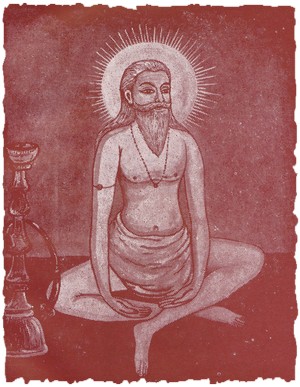
Baba Kinaram

Aghoracharya Baba Kinaram


This lineage had continued in a sleepy state, as if embers under ashes। In the 16th century Baba Kinaram after receiving darshan with Guru Dattatreya in Girnar mountains, awakened it for the welfare of the humanity at large – embers hidden under the ashes began to glow again। In the presence of Baba Kinaram spontaneous relief was received by the suffering, answers to questions came automatically, and mind experienced calmness naturally. One would experience the higher Self merely by being in his presence.

Baba Kinaram traveled far and wide in all the four corners of India & witnessing the suffering of people, engaged himself whole - heartedly in
alleviating their suffering. Finally on the bank of the river Ganges in Varanasi, he established his dhuni (sacred fire) and continued his sadhana of service.
The akhand dhuni (continues burning fire ) of Baba Kinaram fed by the leftover wood from the near by cremation grounds, and the samadhis (tombs) of all the siddhas of the lineage in the same compound, are witness to the continuum of this intact lineage of Aghor Siddhas. Today, this yoga -bhumi (land of sadhana ) of Aghor Siddhas of Kashi (Varanasi) is called Kring Kund where we could get the blessings of Maharaj Shree Kinaram babajee’s Samadahi.

Sant Ravidas


Sant Ravidas was born of humbal parentage at Seer Govardhanpura in Kashi now known as Varanasi, around the 15th century. His parents Shri Santokh Das and Smt. Kalsi Devi were so struck by the divine effulgence of their child when he was born that they named him Ravidas after Sun-Gold. Ravidas did not have any formal education. It is said that when his father tried to admit him in a 'Pathshala', the child Ravidas did not display any interest in his school lessons as even at that early age, he understood that true means of selvation is through love of God and through Bhajan and devotional worship. In his early life, Ravidas was often found in deep meditation for hours togather. Ravidas used to collect boys of his age and explained to them the various modes of adoring God. Ravidas inherited the professio of tanning and shoe-making from his father. But, he was content with making only one pair of shoes in a day. He never desired to make more money than was necessary to keep his body and soul togather. Often he supplied new shoes free of cost to those who could not afford to pay for them. Ravidas often spent his earnings in helping the poor and for feeding the sadhus whom he rspected as men of God. Once, when his father sent Ravidas with some shoes to be sold, Ravidas gave away the whole earnings. Such was his devotion to men of God and his compession for the poor and needy. To divert his attention, his father got him marriednd sattled him eperately. Ravidas lived in a humble cottage but carried on his life of faith and devotion and continued his service to the men of God. Ravidas did not believe in idol-worship. He emphasised the search for Truth and Realisation of the oneness of God. "To recognise oneself is to reach the Almighty God", this is what Rvidas preached LL HIS LIFE. His true devotion towards God was the great source of his successs. He had to face many ordeals in life. He had to face the challenge of orthodox Hindu society which forbade him to wear a sacred thread. or blow the holy marks on his forehead these being meant for only the high caste Hindus. Ravidas being a 'charmakar' was even denied entry into temples. There are many legends about how Ravidas proved his worthness and God-possessed disposition. It is said that when he was brought before the court of Raja Naga Mal, he cit his shoulder and showed the four sacred thread that he wore in 'Satyug', 'Dwapara Yuga,' 'Treta Yuga,' and 'Kalyuaga.' This would not satisfy the orthodox Hindus. Ravidas again performed a miracle by making his 'sila' (a stone used by chamars for making shoes) float on the surface of Ganges, while making the idols of the pandits went down. Raja Nagar Mal admitted Ravidas's greatness and become his disciple. He had further trouble when he went to the Ganga at Varanasi at the place called Panch Ganga Ghat to perform the last rites of his parents, who both died the same day. The publlic is stated to have objected to the waters of the Ganga reaching them after they were polluted by a chamar. It is said that the river changed its flow at the place to accomodate Ravidas. Mira Bai, the famous saint poetess, had great respect for him. It is said that even Sikandar Lodhi, the Sultan of Delhi was impressed by the teachings of Ravidas and honoured hm with presents. Sant Ravidas composed many shabdas. Out of them about 41 shabdas have been included in the Holy Guru Granth Sahib. His shabdas are packed with divine wisdom and in each of them, he advocates the 'Ram nam jap' and extois the efficacy of this great mantra. In his teachings, he says, "God is everywhere - in you and me," and insists, "it is time to worship God." His philosophy was one of surrender to the Lord. He was fully convinced that in Kaliyuga, God's name was the only remedy for salvation. Sant Ravidas was agreat reformer, lover of God and a preacher of saitly disposition, who emphasised the fundamental truth underlying all religions. Born in most humble surroundings in a so-called low-caste family, he proved that "irrespective of caste and creed, all are equal in the eyes of God and only sinful actions bring bad name and dishonour to a man." Though the orthodox society was pitched against him, he never swered from the path of truth and propagated the love of God. He preached love of God and religious harmony as the only panacea for the survival of humanity.  Sant Ravidas.

Friday, 26 November 2010

Sri Arulalap Perumal Emperumanar


Sri Arulalap perumal emperumanar Sri Arulalap perumal emperumanar's birth name was Yajnamurthi. He was a great scholar and an expert in maayaavaada doctrine. He visited the holy Ganges and engaged in debates with many scholars, who were defeated easily. This resulted in a huge following at kasi and eventually, he became a Sanyaasin.
Yajnamurthi was confident that he would defeat anyone in a debate. In the meantime, Sri Ramanuja had set up his ministry at Srirangam and his popularity reached Kasi. Hearing the great ministry set up by Ramanuja, Yajnamurthi wanted to debate him. Hence the traveled from Kasi to Srirangam with a group of his disciples and great fanfare. He met Ramanuja and they agreed to debate for 18 days.
The first 16 days of debate resulted in deadlock. On the 17th day the balance shifted in favor of Yajnamurthi. By the end of that day, they both realized that Yajnamurthi had an advantage over Ramanuja. Yajnamurthi was proud and left the ministry for the day. Ramanuja, was however, disturbed by the turn of events and went into meditating on Sri Varadharaja of Kanchi. The Lord appeared to him in his dream that night and instructed Ramanuja to use Sri Alavandar's work on the incorrectness and illusion of Maayaavaada.
On the final day when Ramanuja entered the debate hall, Yajnamurthi was waiting for him. On seeing the posture of Ramanuja, the energy and his majestic approach, Yajnamurthi was taken aback and accepted defeat, saying that Ramanuja was one with God and no one can defeat him. Ramanuja, lectured him on deficiencies of Maayaavaada, while Yajnamurthi listened with great attention. At the end, he fell to Sri Ramanuja's feet and requested to be accepted into his order.
Ramanuja accepted him and gave him the title Arulaalap perumaaL emperumaanaar, performed the pancha-samskaram and started teaching him the 4000 Divya Prabandam. Since he was a Sanyaasin, he has set up a monastery at Srirangam. During this time, many Sri vaishnavas from far reaching places traveled to Srirangam, with a desire to meet emperumaanaar. Soon there was confusion as to which emperumaanaar were they willing to meet, as there were two of them. On hearing this Yajnamurthi was distraught, tore down his monastery and requested Ramanuja to take him into his fold permanently. So did Ramanuja and named him Devaraat. Ramanuja also composed a work called Nityam, or the methods of worshiping the God, and appointed Yajnamurthi to the daily worship duty at the ministry. Since then, A.P. emperumaanaar never left Ramanuja's side and learned all the truths of Vedanta.

Friday, 12 November 2010

Sri Mudali AndAn

Sri Mudali AndAn

Sri Mudali Andan Sri Mudali AndAn was born in 1027 A.D. at Varadaraja puram near Madras. His parents, Anantha dIkshitar and Naachchiyaar (Sri Raamaanuja's sister), named him as Daasarathi. Since he was one of the foremost disciples of Sri Raamaanuja, he came to be known as Mudaliaandaan.
When Sri Raamaanuja went to Triukottiyur Nambi for upadesam on Tiru mantram, he was asked the reason for bringing Daasarathi and Kuresa with him, inspite of his instruction to come alone. To this, Sir Raamaanuja replied, saying, he had come with his Staff (tiru danda referring to Daasarthi) and Pennant (pavithram referring to Kuresa). Tirukkottiyur Nambi took all three of them and instructed them on the secrets of Tiru Mantram.
Latter, when Sri Raamaanuja was instructing Kuresa on the Charama-Slokam, Daasarathi too wanted to know the meaning of the sloka, and therefore approached Sri Raamaanuja. Due to Tirukkottiyur Nambi's instructions, Sir Raamaanuja, asked Daasarathi to go the him and ask for upadesam on the sloka. Daasarathi went to tirukkottiyur and submitted himself to Nambi, who never gave him contenance. This continued for about Six months and Daasarathi never gave up his resolve. At this point Tirukkottiyur Nambi inquired about his reason for being there. When Daasarathi requested to be taught the meaning of Charama Sloka, he said "Let every trace in thee cease, of the three fold egotism which troubles the mankind, that of talent, wealth and ancestry. Raamaanuja will be the best judge of thee in these matters. Go to him and wait on him and his will and pleasure. He will bless thee". Daasarathi returned to Srirangam, fell to Sri Raamaanuja's feet and related all that happened at Tirukkottiyur. Pleased with Daasarathi, Sri Raamaanuja lauded the change in Daasarathi and started his upadesam on the Charama slokam.
Sri Raamaanuja, latter, started to depend on Daasarathi a lot. While going to kaveri for his daily bath. He used to lean on Daasarathi for support. One day, while on his way to the river, he was asked why, when he donned the robes of a Sannyaasins (ascetic) he did not give up Daasarathi, as that order demanded that all kith and kin should be renounced. To this Raamaanuja replied that Daasarathi was an exception as he was his triplestaff (tirudanda) (the same reason he gave to Tirukkottiyur Nambi) and added "If it is possible for me an ascetic to give up my staff only then can Daasarathi leave me. He, though a bodily relation, is yet a kin to my soul."
When Raamaanuja went to North India to collect the work of Brahma Sutra, he left the Srirangam temple activties in the hand of Daasarathi. Daasarathi composed the taniyan to be sung before Mutal Tiruvantati. He was very well educated in both the Sanskrit and Tamil Vedas and instructed many such as Embar and other on the meaning of Tiruvaimozhi and other paasurams of the 4000 Divya Prabandham.

Wednesday, 3 November 2010

Sri Koorath Azhvan (Kooresa)


Sri Kuresa was born in a village called Kooram near Kanchi in A.D 1008. His parents, who were extremely rich, named him Sri Vatsangar. Because of his background he was called Kooranaatha or kooresa.
When he heard that Sri Ramanuja had joined the monastic order, Kooresa and Dasarathi rejoiced and proceeded to kanchi, where Ramanuja initiated them into Sri Vaishnavam, by performing Pancha-samskaram. Kooresa and Dasarathi were the first disciples of Ramanuja. It is believed that both Dasarathi and Kooresa are the incarnation of the divine symbols of Lord Vishnu, namely, the Conch and the Discus respectively.
After studying under Ramanuja for a while, Kooresa returned to Kooram. There he was very generous with his wealth and used to feed and cloth anyone who came at his door. It is said that the doors at his mansion would close only after the doors at Kanchi Varadaraja Perumal Temple closed.
One day the doors at his mansion closed earlier than usual. The next day, Kanchi Poorna visited him inquiring about the reason for closing his mansion's doors before Sri Varadaraja's doors closed and added that it was the Lord's wish to get an answer from him. On hearing that the noise from his mansion's doors disturbed the Lord, he resolved to forego all his possession and join Ramanuja at Sri Rangam.
Soon Kooresa and Andaal (his wife) were on their way to Sir Rangam. They were walking through a thick forest, which Kooresa's wife was not used to. Soon she stopped Kooresa and asked him if the path they had taken was safe. To this, Kooresa replied, there was no reason to be afraid as long as they do not have anything of value with them. Smt Andaal replied that she had brought a small cup made in gold to fetch water for Kooresa. He immediately took the cup and threw it away, saying her fears has been defeated. When they arrived at Sri Rangam, Ramanuja invited them with a warn reception. Kooresa and Andaal then made Sri Rangam as their home.
Kooresa assisted Ramanuja in writing the Sri Bhasya. It is said that, he accompanied Ramanuja to Kashmir and studied Bodhayana-vriti; a gloss on the Brahma-sutras, which was available only there. He committed the entire text to memory when the authorities in charge of the manuscript did not permit Ramanuja to take it with him. He helped Ramanuja in writing the Sri Bhasya by reciting the relevant passages of the Vritti.
When Ramanuja was ordered by Kulottunka to appear before him and admit Siva's supremacy, kooresa feared for Ramanuja's life. He convinced Ramanuja to switch robes and appeared before the king in Ramanuja's ascetic robes. He lost his eyes when he was not able to create conviction in favor of Vishnu in the mind of the King. His devotion to the Lord was such that he was able to visualize the divine vision of Lord Varadaraja at Kanchi and describe Him to Ramanuja.
Kooresa and Andaal had two sons, Parasara bhattar and Vedavyasa bhattar, who became great scholars during their times. Kooresa composed five poems, collectively known as Panchasthavam, in addition to some Granthas. The five poems are:
  1. Sri Vaikuntha Stava
  2. Sri Atimaanusa Stava
  3. Sir Sundarabaahu Stava
  4. Sri Varadaraaja Stava
  5. Sri Stava

Shri Ramanuja

Shri Ramanuja 
 
Sri Ramanuja
(also known as Ilaya Perumal) was born to Kesava Perumal Somayaji Dikhsitar and Kanthimathi Ammal at Sriperum pudur. He was born in Kaliyuga year 4119 which corresponds to1017 AD. PPM fixes even the exact date as 13th April 1017 AD, interms of English Calendar (the date of birth is placed differently by different authorities). Within 16 years of age, he had mastered all the Vedas and Sastras. At age 17, he married Rakshakaambaal ( Tanjammal, in Tamil).  Ramanuja was placed under the Advaitic Sannyasi called Yadava Prakasa at Tirupput kuzhi for training in Advaita Purva Paksha Sastra of Vedanta. Very many occasions arose when the Ramanuja clashed with Yadava when he  misinterpreted Vedantic statements. Ramanuja fearlessly pointed out the errors in his Guru's interpretations and corrected him. This enraged the Yadav. Fearing that one day, Ramanuja  would demolish Advaita philosophy, he plotted to kill him by drowning him in river Gangess while on a pilgrimage tour of the country with his disciples. Learning of the design through one Govinda, another disciple who was also related to him, Ramanuja  slipped out into the forest at dead of night and escaped death.
Once during this period, Alavandar who desired nominating Ramanuja to succeed himself visited Tirupput kuzhi, met with him but had no opportunity to speak to him and had to return to Srirangam. When Alavandar was old and sick he sent Periya Nambi to bring Ramanuja to Srirangam. However, before they could reach Srirangam, Alavandar attained Vaikundam. Ramanuja returned to Kanchi after promising to satisfy the three requests from Alavandar:
  1. Compose a commentary on Upanishads, Vedanta Sutras and Bhagavad Gita
  2. Compose a commentary on Tiruvaymozhi of St. Nammaazhvaar
  3. The name of Parasara, should be commemorated on the earth by giving it to a person worthy to bear it.
Ramanuja returned to Srirangam after taking up the ascetic order. Ramanuja's two important disciples, Koorathazhcan and Mudaliandan accompanied him and stayed with him at Srirangam. While in Srirangam he made sure that Alavandar's teachings and his desires are met. He became popular and converted many to Sri Vaishnava Sampradhayam, including Yadava Prakasa, who became his disciple.
While in Srirangam he composed many works such as Vedanta Sangraham, Vedanta Sara, Vedanta Deepam, and Geetha Bashyam. During Panguni Uttram, he did Prapatti before the Divya Dhampathi in Serthi and submitted his famous Gadhyatrayam
(comprising Saranagathi Gadhyam, Sriranga Gadhyam and Sri Vaikunta Gadhyam ). Later, he wrote a Grantha called Nityam detailing the Tiruvaradhana Kramam.
He wanted to know the meaning for the secret mantra,  known as tirumantra. So he approached Tiruk kottiyur nambi, a disciple of Alavandar. Nambi refused to grant his request and made him go back to Srirangam. This continued for about 17 times. On his 18th attempt, Nambi oblidged Ramanuja's request and started teaching him the meaning of the mantra. At the end of the upadesam, Nambi extracted a promise from Ramanuja that he would not reveal the mantras to those unqualified to receive them. However, the following day, Ramanuja went to the nearby temple hall of terk kazhvan at tiruk kottiyur and announced the sacred mantra to all those assembled there. When Nambi heared this, he demanded an explanation from Ramanuja for his direct disobedience. To this, Ramanuja, replied that if the act of his results in thousand souls reaching Vaikundam, he would be glad to be burned in hell (Burning in hell is the punishment for those who disobey their guru's commands). On hearing the explanation, Nambi was speachless and embracing him gave him the title Emperumaanaar. Since then Ramanuja's followers are known as Creed of Emperumaanaar.
In order to fulfill his promise to Alavandar, Ramanuja and Koorathazhvan went on a pilgrimage to North India. There they studied the text of Vedavyasa's Brahma Sutram. With the help of Koorathazhvan's memory, he was able to write a commentary, Sri Bashyam for the text. Thus he fulfilled the First promise made to Alavandar.
One day, while he was meditating in silence, on one of the paasurams of Tiruvaimozhi, one of his disciples called Pillan walked in and inquired if he was meditating on the particula hymn. Sencing the vision of Pillan, Ramanuja entrusted the task of writing a commentary on Tiruvaimozhi to Pillan. When the commentary was written, Ramanuja titled him Tirukkurugai Piraan. Thus his second promise to Alavandar was fulfilled.
When koorathazhvan had two children, both boys, Ramanuja and Govinda visited him. Ramanuja was very happy to see the two bright boys and ordered Govinda to perform pancha-samskaram and name them as Parasara Bhatta and Vyasa Bhatta, thus fulfilling the third and the final wish of Alavandar.
Ramanuja, restored many temples to the Vaishnava tradition, including Tirumala, Melukote (Tiru Narayanapuam). He was a great social reformer, and converted many irrespective of cast origins to Sri Vaishnavam and taught them Divya Prabandam. He established a list of 74 Simhasana Adhipathis for the sole purpose of promoting and teaching Sri Vaishnavam. With his head on the lap of Embar and his feet on the lap of Vaduga Nambi, Ramanuja breathed his last in 1137 AD listening to the recitation of the Divya Prabandam 

Saturday, 2 October 2010

Thursday, 3 June 2010

Shri Potuluri Veera Brahmendra Swami

Shri Potuluri Veera Brahmendra Swami

 sri-potuluri-veera-brahmendra-swami.jpg 

Sri Potuluri Veera Brahmendra Swami, a Hindu mystic, Born in 1610 C.E. in Cuddapah Andrapradesh. He is the writer of Kalagnana, an important text in telegu that predicts the arrival of Kalki in the form of Sri Veerabhoga Vasantaraya. This predictive text also talks about important events in the future. His philosophic talks Next to “Bhavishyat Purana” a prognostication of mankind’s future Kala Jnana Tatwa of Sri Pottuluri Veera Brahmaendra Swami offers a glimpse of events and trends destined to take place in the coming decades.

Tuesday, 20 April 2010

Shri Manik Prabhu Maharaj

Shri Manik Prabhu Maharaj


Shri Manik Prabhu Maharaj(1817-1865)
The great mystic saint and yogi Shri Manik Prabhu Maharaj (1817-1865) is hailed as the fourth incarnation of Lord Dattatreya and has an enormous following in the country. Shri Saibaba of Shirdi, Shri Akkalkot Swami Maharaj and Shri Gondavalekar Maharaj were Shri Prabhu’s contemporaries and they interacted with him on matters of deep spiritual wisdom. Shri Prabhu was also associated with the first war of Indian independence in 1857. All biographers refer to Shri Prabhu as a saint of great spirituality and mysticism.
He is hailed as ‘Bhaktakarya Kalpadruma’. Stories of his miracles and eye witness accounts, which bear testimony to the manner in which he brought succor to the distressed and the sorrowing, to the afflicted and the wronged, who, ardently and with deep faith sought his spiritual intervention are available. 
Shri Prabhu’s teaching, basically, lay stress on the path of Bhakti. Alongside, he moralizes in the most remarkable manner on the ‘Vedantic Truths’ concerning the ‘Spiritual Unity’ of beings. Shri Prabhu uses his theological platform beautifully, to unfold, interpret and even reason out the concept of ‘ Ultimate Reality’.
His innumerable poetic compositions are replete with expressions of ardent devotion to the different manifestations of Parabrahma. In the final analysis, he enjoins a meaningful connection between man and man, in a spirit of fellowship and brotherhood, disregarding affiliations of religions, caster of creeds.
Such a philosophy invited messianic reverence for Shri Prabhu from all communities and earned him the appellation ‘Sakalamatacharya’. Sakalmata Sampradaya is not a cult or a sect. It is a holistic and an all embracing school of philosophy, which basically rests on the concept of a Supreme Soul that pervades the Universe and in that context perceives a spiritual unity in the entire human race. 
This school of thought holds an umbrella of eqality over all diversities of religions, faiths, and persuasions. Such a philosophy was readily acceptable to people of all religions, castes or creeds, and to rich and poor, as it held the promise of harmony among all people, transcending all barriers that produced conflicts.

Hazrat Tajuddin Baba

Hazrat Tajuddin Baba


Hazrat Tajuddin Baba was  Perfect Masters  of his Age. Such is the play of nature known as maya (illusion) that this Perfect Master was declared a lunatic and kept in confinement in the Nagpur Lunatic Asylum for more than sixteen years. However, Baba Tajuddin started his divine play from this place and virtually converted the asylum to a place of worship.

Baba Tajuddin was born on the 21st of January in the year 1861 at a place called Kamthi situated near Nagpur in the state of Maharastra.

From the birth itself, there was something unusual about the child, for the new-born baby would not at all cry. He would, at times, open his eyes and look at people and again go to sleep. All normal methods to induce the child to cry having failed, the parents took recourse to a traditional shock method of touching hot iron to the forehead and ear of the child. With the application of this method the child jerked out of its stupor and started crying. The burnt marks thus made on the head and ears of the child remained on his body till the last.
More often-than-not, it is seen that highly developed souls become orphans in their early childhood so that they become free to operate in their spiritual world. This had happened with Shri Shirdi Sai and this also happened with Baba Tajuddin. His father expired when he was about one year old and his mother expired when he was only nine years old. The care of this orphan was taken over by his maternal grandmother and maternal-uncle Abdul Rahman. As a child, Baba started his education at the age of six in a local madrasa in Kamthi.
During this time a spiritually - developed soul, known as Hazrat Abdulla Shah, visited the madrasa and saw the child Tajuddin.
He immediately told the teacher - "Why are you teaching this child. He has got all knowledge from his past life." Saying thus, he took out a dry fruit (Khumani) from his bag, ate half, and put the other half in the mouth of the child saying "Eat less, sleep less and speak less. Read Quran”.
As soon as the child ate the dry fruit, God - consciousness dawned on him and for about three days he remained in a state of spiritual ecstasy.Obviously Hazrat Abdulla Shah had given Tajuddin the spiritual power or consciousness known as "Shaktipata" in Hindu Yoga system. Thereafter, the child was found to be always in a state of contemplation in secluded places.
At the age of 18, the financial condition of his maternal - uncle's house deteriorated due to floods. As a result, both Baba and his maternal - uncle searched for a job. In 1881, at the age of 20 Baba joined the Nagpur Army Regiment. Soon a contingent of the Regiment, where Baba was serving, was sent to a place called Sagar. At Sagar, Baba used to manage his duties as an army sepoy (soldier), somehow spending the best of the time in doing namaz and contemplation. Most of the nights he used to spend with a highly developed spiritual soul known as Hazrat Baud Saheb under-going spiritual practices. Hazrat Baud Saheb is, therefore, recognised as one of the spiritual masters of Tajuddin Baba. His absence from the army camp at nights, and his least regard for the service created problems from the higher authorities. One day, in a God-intoxicated state Baba suddenly submitted his resignation from the army and left the camp.
He then roamed about in the streets of Sagar like a mad man; without any sense of body. Soon his maternal grandmother heard of the news and took him away to Kamthi. She tried to get him cured through doctors and Hakims thinking that he was mad. The doctors and Hakims could hardly improve his condition as Baba Tajuddin's consciousness had, by that time transcended the gross and subtle body and was floating in the vast ocean of divine consciousness - beyond multiplicism and dualism of Nature. As the destiny of many spiritual seekers, children started throwing stones at him to which he would never react. The society around him discarded him to be useless for their purpose and declared him as mad and, therefore, humiliated him whenever and wherever they could.
However, miracles also started taking place around him. He would suddenly tell people about their past and warn them about future problems. One day in that Videha State (Beyond body state) he went near a British woman in a naked state. The horrified woman complained to the army authorities about such uncivilized behaviour. An army officer caught hold of him and got him admitted in the lunatic asylum of Nagpur on the 16th of August 1892. This is one of the biggest illusions of Nature (Maya) the mad people of the mad world declaring the Knowledge- Incarnate, who had come to redeem them of their worldly madness, as mad. But how could the authorities, confine a soul that is in a state of pure consciousness within the four walls of a lunatic asylum. As was the practice, the inhabitants of the asylum used to be locked up in barracks and cells at night. Similarly, Baba was also put in confinement under strict vigil.
Soon after he was locked up in the asylum that a strange incident took place that spread Baba's name far and wide. Baba was admitted in the lunatic asylum on the 26th August 1892. On the same day many people saw him moving freely in the streets of Kamthi, even after he was locked up. On the next day i.e. 27th an army sepoy, who, under the orders of the magistrate had brought Baba to the lunatic asylum the previous day, saw Baba roaming in the street. The shocked sepoy ran back and informed the British officer of the regiment, about it. The officer immediately rode his horse and searched for Baba. He ultimately found him sitting under a tree smiling at him. British officer was so enraged at seeing him moving freely that he straight away rode to the lunatic asylum at Nagpur situated at half an hour distance from Kamthi. He asked the doctor on duty “Where is that insane whom I sent here yesterday?” The doctor informed that he was in a locked room and also showed the officer where Baba was locked, and behold, the officer found the Baba Tajuddin was sitting inside the room in the same posture in which he had seen sitting under the tree only half on hour back smiling at him. On seeing the officer, Baba said. " Brother, you are doing your work and I am doing my work". The officer was so influenced by the divine personality of Baba that he instantly became his disciple and started visiting Baba on every Sunday with his family members. Thereafter, the asylum authorities were reconciled with Baba moving at various places inside the asylum compound and outside. Gradually, Baba’s name became so famous that thousands of people from near and far started lining up before the lunatic asylum everyday to have Baba’s darshan, blessing and help.
During his 16 years stay in the asylum, Baba cured thousands of people of diseases , granted children to the childless and took on his shoulders the responsibilities (both temporal and spiritual) of lakhs of his devotees.
Miracles are the way of functioning of the Masters. Since more often, they work through the subtle and mental mediums than in gross which ordinary mortals cannot perform, they are termed as miracles. The forces creating miracles are subtle forces of nature not yet discovered. Since the work of the Perfect Master precipitates hundreds and thousands of actions at different place at the same time, they employ the subtle methods. Those who have become mediums of miracles know for sure that there are definite principles on which the so called miracles operate. For them they are not miracles but a normal way of functioning at their levels of consciousness.
The Perfect Master are not confined by any religion, any creed, caste or even by scriptural injunctions or prescribed methods of worship etc. They are in a state of total 'freewill' without any limitations of nature. This is not to be misunderstood, as a negative state of assertion for free will. Baba's fame and love for people had been drawing thousands of people daily to the lunatic asylum. Even the staffs of the asylum including the doctors were his devotees.
The doctor gave report that Baba was not mad but a person of unusual qualities which medical science cannot explain. In the meantime, Maharaja Bahadur Shrimant Raghoji Rao Bhonsle, the Maharaja of Nagpur had become an ardent devotee of Baba and started visiting him regularly. One day, in the evening, he thought of getting Baba released from the lunatic asylum and bring him to his palace at Shakardara. The same night, he saw a vision in the dream in which Baba appeared and pointing towards Red Palace said "Oh, elder brother, let me stay here." It was early morning- (3.00 AM) of 9th July 1908, a Thursday. The Maharaja immediately called his officials and discussed about the steps to be taken to get Baba released. The Council decided that the Maharaja should immediately make an application for release to the Governor, Central Provinces. Ultimately after depositing a security money of rupees two thousands, the Maharaja secured the release of Baba on the 21st of September 1908 and brought him to his palace. From his palace Baba started his divine work.
Once Baba was lying down on the sands of the river Kanhan when two ladies by the name of Shantabai and Subhadrabai from Amaravati, approached him. While touching the feet of Baba they mentally prayed to him for children, as they were childless. The omniscient (Pragyan Ritambhara) Baba heard their inner prayers and gave a ladoo (a type of sweetmeat) to each after testing them. He blessed them to have sons. While they were returning, Shantabai ate the ladoo as a blessed prasad, but Subhadrabai did not because Baba had tasted the ladoo and was Muslim by birth. She quietly got the ladoo buried in the sand. As the Divine Will could have it, Shantabai got a son nine months later. When the child was about two-month-old, she came to Baba with the child for his blessings. Subhadra, who had not conceived even by that time, accompanied her. When Shantabai put her child at the feet of Baba, Subhadra could not control herself. She fell at the feet of Baba and cried -" Baba where is my child?" Baba told her to search the child from beneath the sand (indicating that he knew where the ladoo was) Subhadra immediately realised her mistake and repented profusely before Baba. The Perfect masters are incarnation of kindness. Her repentance and plight moved Baba. He blessed her to have a son, which she got after a year. The perfect master is a wish- fulfilling tree Kalpvriksha who even shower unconditional grace (Ahetuk Kripa).
A poor scheduled- caste woman called Tara once wished to feed Baba but since Baba was staying in the palace. Tara did not know how to approach him and was also afraid that some people may not take it kindly. So, she cooked the food and tied the food in a piece of cloth with a tree near the palace. Sometime later, people from high classes kept the best of dishes before Baba for his lunch. Baba Said, " I will not eat all these. Get my food tied in the Jamun tree". Everybody started searching but could not find the food. Ultimately Baba got up from his seat, brought the food from the tree and ate only that with utter satisfaction. The Perfect Master are hungry not for the food offered by the people but for the love behind such offer. The spiritual masters never encourage anyone to change his religion. They are above all religions. They only see the theme of humanism, which is the basis of all religions.
There was a prostitute by the name of Giriji who was a devotee of Baba. Suddenly, she caught some disease and remained sick for long. Another devotee of Baba, Kashinath Patel, one day sent a person to the house of Giriji to enquire about her health. The man came and found Giriji dead and informed Kashinath accordingly. Kashinath directed him to go and ask Tajuddin Baba whether to bury the body of Giriji or to burn it. On his way to Baba's place, he found a close attendant of Baba carrying tea in a pot. During discussion, Patel's man told the attendant of Baba that Giriji is dead. When Baba's attendant heard that Giriji is dead he told the other persons that Baba has asked him to ensure that Giriji drinks that tea. Therefore, he insisted on carrying the tea to Giriji, Both of them reached Giriji house and found her body surrounded by mourning women. The attendant of Baba, said in a loud voice - "Giriji, Hazur has sent tea for you. Take it." He repeated the sentence thrice. After the third time Giriji opened her mouth and little by little tea was poured in. After taking the tea, she came back to life and lived for a few years more.
The love of a Perfect Master for his devotees is somewhat like but more than the love of the mother towards the child. Whosoever surrenders to him, he takes care of his biggest and even the smallest problems. Since his words are the ultimate truth, whatever they promise is fulfilled, even after they have left their body. Let us see one example. Sometimes, Baba used to travel in a horse-driven cart to distant places. One devotee named Hiralal used to be his driver (coachman). When Baba once declared that he would leave his body in few days (he left the body on the 17th of August 1925), Hiralal started crying. He asked Baba "Huzur, under whose protection are you leaving us and going". Baba told him "you always stay in front of me (the driver sits at the front in a horse cart) and I will always stay behind you".
It so happened that in 1965, on the day of the Moharram, the annual procession i.e. Baba's Tazia started from Baba's place by now name as Tazabaad and moving towards the main square (called Jhad Square) with people shouting 'Allah ho Akbar'. Suddenly the people carrying the Tazia heard the cry 'Ram naam satya hai' from another procession moving in front of them. Those who knew what Baba had told Hiralal during his last days, found that the procession in the front was carrying the dead body of Hiralal. Tears rolled down from their eyes when they saw Hiralal's body going in front and Baba's Tazia following a promise kept by Baba forty years after his departure. One of the main functions of a Sadguru is to stand by his devotees at the times of their death, in gross or subtle form, to lead the soul towards further evolutions. None else - i.e. no other Guru, parents, relatives, or even yogis have the power to render such help to the souls once they have left the body.
By 1925, Baba had completed his 64th year. In the month of August his health started deteriorating. Maharaja Raghoji Rao pressed the best doctors for service, but which doctor could cure Baba who only had decided about his departure. Raghoji Rao understood that Baba is getting ready to depart. He asked Baba to allow people to have darshan even if medical advice did not permit. The ever-benevolent Baba just smiled and agreed. As the news spread thousands of people came to the king's palace and had last sight of their beloved master who had served and protected them for decades. The stream of visitors continued till the last moment of Baba’s departure on the 17th August 1925. On that Monday, Baba lifted his hand as blessing to all, looking at them lovingly and quietly laid his body on the bed. By the time doctors could check him he had already left the gross body for its universal abode. But, today the experience of people visiting the Samadhi of Baba establishes the truth that the Perfect Masters always exist, in whatever form, in the time continuum for they are in the Beyond state.

Dhruv

Dhruv


Dhruv was the son of King Uttanpad.


The king had two wives: Suruchi and Suniti. Suruchi had a son named Uttam and Suniti had two sons. Dhruv was Suniti's eldest son. Suruchi was the king's favourite queen. Whilst the king loved her and her son Uttam, he ignored Suniti and her son. Once Uttam sat in his father's lap. Dhruv too tried to sit beside his stepbrother. At this Suruchi shouted to him, " You cannot sit there. If you want to sit in the king's lap you shall have to prove your worthiness and undergo serious penance."


Dhruv could not bear the insult and he resolved to go to the forest and please Bhagwan Vishnu by praying to Him. On the way he met Naradji, who tried to stop him. "You are just a small child. The forest is full of dangerous animals. How will you bear the winter's cold and the summer heat. Go back home," he said. Dhruv replied, "O learned sage! Even at the cost of my life and all the rigours of the forest, I will prove myself worthy to sit in the lap of the king, my father, by undergoing great Penance and pleasing God." Penance means to fast, to meditate and to live a very simple life. Naradji was pleased with Dhruv's dedication and fearlessness and he showed him the place and the method to practice penance. Then Dhruv reached a place in the forest called Madhuvan. He stood on one leg and started praying to God. Dhruv was so absorbed in his penance that the difficulties of forest life did not affect him at all. He had only one goal - to please and to meet God. He prayed for more than five months, standing on one leg. One day Bhagwan Vishnu was pleased with his devotion and He appered before Dhruv. "I am pleased with your devotion, my child. Tell me, what do you wish?" Bhagwan Vishnu asked Dhruv.


"O God, I wish your blessings and love from my parents," Dhruv replied.


"All your wishes shall be fulfilled my child." Saying this he vanished.


Dhruv had achieved his goal. He had pleased God and had met him. Now he returned to the kingdom. The king welcomed Dhruv with full honor and respect. Suruchi, too, hugged Dhruv and he became everybody's favorite.


Later, Dhruv was made the king and he served people with love and dedication.


Dhruv is remembered by all for his strong determination.


God graced him with an eternal status in the heavens.


Even today we know him as the Dhruv star, the northern (pole) star.

Bhaktha Prahlada

 Bhaktha Prahlada


Bhaktha Prahlada, the putra of Hiranyakashipa and Leelaavati:


When Prahlada was in the garbham of Leelaavati, his pita, Hiranyakashipa did a severe Tapas for Brahmadeva. Hence Leelaavati had the adrushtam of staying in the pivitra aashramam of Naarada maharshi. Due to the tapashshakti of Naarada, snakes-vultures, lions-elephants and other such animal pairs which have natural enemity, left their anger on one another and were co-existing in peace. Because of living in such an environment, Leelaavati used to always think about good and used to listen to the puraanams told by Naarada maharshi.

One day, when Naarada maharshi was describing Shri Hari Leelas and greatness of Hari-bhakti, Leelaavati slept off, but Prahlaada who was in her garbham was listening a telling “ok” “ok” to all the tattvam that Naarada maharshi was telling. Thus even before Prahlaada was born he got Gnyaanopadesham from Naarada maharshi. On one shubha-lagnam, Prahlaada was born. Devatas showered pushpa-varsham.
Brahmadeva, who was impressed by the severe Tapas of Hiranyakashipa, appeared before him and said “Vatsa! Your tapas is advitiiyam. Ask Me your abhiishtam and i will grant it”. Hiranyakashipa had duraasha. He believed this shariiram is shaashvatam and satisfying physical senses itself is aanandam. Hence he asked Brahmadeva “Svaami! I must have no maranam (death)”. Brahmadeva said “Kumaara! This is against Shrushti-niyamam. Ask any other varam”. Hiranyakashipa asked “Either on land, in water, in fire, in air, in aakaasham, by animals or humans or deva-daanavas or yaksha or kinnera or siddha or vidyaashara adi praanis, by any shastra-astras, during day or night I must never get maranam. Also I must always have vijayam in yuddham, I must get more power than Indra aadi loka-paalakas and be the King of Tribhuvanams”. Brahmadeva replied “Kashyapa-putra! no one ever asked such varams previously. But since you have done tapas and impressed Me, I am granting you this varam. But be a buddhi-sampanna and live”.
Even though Hiranyakashipa was putra of the great Kashyapa maharshi and had great tapashshakti, he got ahankaaram because of the varam he got from Brahmadeva. He, with his vara-gravam, forgot that Brahmadeva said “be a buddhi-sampanna and live”, and started to torture worlds, saadhu-sajjanas, pativratas. Who can save a fly that gets attracted to fire and gets burnt? He started saying he is only God, everyone should pray to him and do pooja to him. His paapam was increasing day-by-day and finally by torturing his own child, Prahlaada, who was a great Shri Hari bhakta, he himself became the cause for his death:

Hiranyakashipa tried to torture Prahlaada by throwing him down cliffs, getting him stamped by elephants, burning him in fire etc., but nothing happened to the great Hari bhakta. Prahlaada, who had only Shri Hari in his mind, never even thought about anything else. Hence Shri Hari saved him from the tortures of Hiranyakashipa.


One day at Sandhya-samayam, fed up with Prahlaada saying Shri Hari is only Paramaatma, His bhakti is only shaashvatam, Hiranyakashipa said “where is your Hari? I even went to Vaikuntham and searched for him to kill him, but he was not there. There is no Hari. I am only Bhagavaan”. Prahlaada replied “Dont have the doubt that He is here, He is there. He is everyone. Wherever you search for Him with Bhakti, He will be there”. Then with anger Hiranyakashipa said “is it? If so, show Him to Me in this pillar”. Then Mahaavishnu appeared from the pillar in the form of Nara-simham, placed Hiranyakashipa in His lap, and teared him into pieces using His nakhas (nails).


Thus even though Hiranyakashipa asked for a varam so that it was difficult to kill him, he forgot the fact that Paramaatma is more powerful and his duraasha, ahankaaram only lead to his downfall.

Shree Basaveshwara

Shree Basaveshwara


Shree Basaveshwara was the reviver of the Veerashaiva ( Lingayats) religion. He advocated the equality among the humankind and condemned all barriers of caste, creed and sex etc. and showed the right path to the society which was
lost in the darkness of casteism,which makes him a Unique saint, hence he was known as Jagajyoti ( a devine light for the world ). He is also known as Krantikari Basavanna
for his revolution in the caste ridden society.
Shree Basaveshwara was born in a brahmin family, to Madarasa and Madalambe in 1131 AD in Bagewadi. Madarasa was the chief of Bagewadi, now known as Basavanna Bagewadi is in Bijapur district, Karnataka, India. It is observed that Basaveshwara was an incarnation of Nandi the vehicle of lord Shiva, as Madalambe gave birth to a son after observing the Nandivrata. Basaveshwara had a sister Akkanagamma and a brother Devaraja.
Upanayana was done when Basava was eight years of age. He was made to wear the sacred thread called Janivara and worship the holy fire reciting “Gayatri” mantra and perform many complex rites. Soon after this, his both parents died and was looked by his grandmother. Basava was in no way convinced by the Upanayana ceremony and the subsequent strict observances because they were administered by the persons who had no true insight. This made him revolt against the ritualism. At the age of 16 years Basava discarded Janivara and broke away from the brahmanical
religious traditions. He then proceeded to Kudala Sangama, then the Shaivite stronghold.
Kudala Sangama is now a village in Hunagund Taluk of Bijapur District and situated at the meeting place( Sangama or Junction ) of two rivers, the Krishna and its tributary the Malaprabha.
Basava found his guru at Sangama and with his guidance, plunged himself into study and devotion to Sangameshwara the presiding deity of Sangama. He spent 12 years at Sangama which was the most significant period of his life. He had established the contacts with many learned
Brahmin scholars who were less orthodox in social and religious affairs.By this time Basava had come to a conclusion on spiritual, religious and social aspects of life. His views were:
There is one God , he is real, universal and supreme. He is perfect,noble, compassionate and he is always present to help the true devotees. No other God could attain his dignity and he is SHIVA,who is worshipped in the form of linga, the symbol of infinity.
The Jangamas, true devotees of Shiva, who propagate his gospel deserve the highest respect. The humanity which went astray in search of unreal God and false faiths should be brought back on the right path. The society suffering from artificial distinctions and discriminations needed reform and revival.
Basava married Gangambike the daughter of his maternal uncle Baladeva, who was a minister in the King Bijjala’s court at Mangalaveda.He had another wife, Nilambike ( Nilalochane). He had a son named Balasangayya.
Later he found a job in Bijjala’s court. Bijjala changed his seat of power to Kalyana and Basaveshwara followed him. Basaveshwara became the minister to King Bijjala in 1162 AD. As the minister Basaveshwara established the spiritual parliament, known as ANUBHAVA MANTAPA, to discuss the various aspects of Veerashaivism with the people from all walks of life. The dreams of Basava dreamt in Kudala Sangama, were being realised at Kalyana. His Bhakti movement brought great saints from all over India to the Anubhava Mantapa. The fundamental principles of religion, philosophy and society were discussed at a great length. The great Vachana Literature took final shape.
Basaveshwara was not only a minister by now he was the central figure of the socio-religious revolution ( Kranti) and condemned the barriers of caste, creed, sex etc. He had established the shunya pitha in the Anubhava Mantapa as the symbol of the new religion, which was being advocated by the Shivasharanas in 1154 AD. Allamaprabhu ascended the shunya pitha in 1162 AD. Kalyana attracted sharanas and jangamas.
Basaveshwara’s life long aim was to eradicate the deep rooted varnashrama or the caste system. Though he was the minister, he used to invite the untouchables to his residence and have meals with them. This act incited the hatredness among the orthodox people who were jealous
about the Basaveshwara’s great achievement. They carried many false stories to King Bijjala to malign Basaveshwara. These accusations created suspicion in the mind of Bijjala and he was fearing about the uprising of traditional and orthodox society, if the accusations were proved to be true.
As if adding fuel to the fire, the historic marriage between the daughter of Madhuvayya a Brahmin and the son of Haralayya an untouchable took place in Kalyana. This marriage was blessed by Basaveshwara and many sharanas, but this infuriated the traditional people in the society and they complained the King Bijjala. The king ordered, Madhuvayya and Haralayya be punished by removing their eyes and dragged in the streets by elephants. Basaveshwara was unable to stop the punishment and his
sensitive mind could not bear this shock. He took the blame for this upon himself. He felt that his mission in Kalyana has come to an end. With great sorrow in his heart he left Kalyana in 1167 AD and went to Kudala Sangama.The chaotic conditions prevailed in Kalyana and the sharanas were very much distressed by the developments. Mean time the king was
murdered.
Three months after reaching Kudala Sangama Shree Basaveshwara attained the union with Lord Kudala Sangameshwara in 1167 AD . Following is one of the thousands of vachanas of Shree Basaveshwara:
The power of knowledge destroys ignorance;
The power of light dissipates darkness;
The power of truth is foe of all untruth;
The sharana’s experience of god is the sole cure of worldliness;
O Lord Kudala Sangamadeva.

Swami Vivekananda

Swami Vivekananda


A spiritual genius of commanding intellect and power, Vivekananda crammed immense labor and achievement into his short life, 1863-1902. Born in the Datta family of Calcutta, the youthful Vivekananda embraced the agnostic philosophies of the Western mind along with the worship of science.

At the same time, vehement in his desire to know the truth about God, he questioned people of holy reputation, asking them if they had seen God. He found such a person in Sri Ramakrishna, who became his master, allayed his doubts, gave him God vision, and transformed him into sage and prophet with authority to teach.

After Sri Ramakrishna's death, Vivekananda renounced the world and criss-crossed India as a wandering monk. His mounting compassion for India's people drove him to seek their material help from the West. Accepting an opportunity to represent Hinduism at Chicago's Parliament of Religions in 1893, Vivekananda won instant celebrity in America and a ready forum for his spiritual teaching.

For three years he spread the Vedanta philosophy and religion in America and England and then returned to India to found the Ramakrishna Math and Mission. Exhorting his nation to spiritual greatness, he wakened India to a new national consciousness. He died July 4, 1902, after a second, much shorter sojourn in the West. His lectures and writings have been gathered into nine volumes.

Wednesday, 7 April 2010

Ma Anandamayi

Ma Anandamayi


...

Sri Ma Anandamayi today is widely recognized as a personality of great spiritual eminence. She was born a hundred years ago and she took samadhi at the age of 86 ; these limitations, however, cannot said to have conditioned her utter freedom to be just herself under all circumstances. She was the embodiment of a joyous self-sufficiency, which enraptured the hearts of all who came near her.

The mysterious aloofness of her personality was totally beyond human understanding and yet it was so tempered by her compassionate love for all living creatures that she seemed closer than the most indulgent friend ever could be. She was the Teacher whose guidance was sought by the learned as well as the simple, the old and also children, people from alien cultures or from traditional backgrounds.

Although she travelled incessantly, it was seen that she was at home everywhere and no one was a stranger to her. Throughout the length and breadth of India and also beyond its shores people found her to be, as if the personification of their own inner vision of the Adored one who is most dear to their hearts.

In Dhaka where she first gained recognition, She was known as "Manush Kali", that is, the 'living Kali'. Kali is the presiding Deity of Bengal so that was quite understandable. When she moved out of Bengal and visited other provinces, her presence elicited the same type of response, even at her first appearance. On the shores of the Holy Narmada, she was greeted as "Devi Narmada". In Madurai she was hailed as the Goddess Minakshi by surging crowds who waited hours for a glimpse of her. In the Punjab she was given the same place of honour as the Holy Granth Sahab. In Vrindavan, the much-respected Mahatma, Sri Haribabaji Maharaj saw in her his adored Deity, the Lord Gauranga. The Sindhi devotees of Sri Udiyababaji Maharaj paid her homage as the visible Form of their Deity Jhoolelal. One Muslim devotee used to a see a vision of her with a Taj on her head during his meditations. A Christian devotee remarked quite spontaneously "Now we have a Face to put on God". The simple highland women of Almora would say to her, "Now that we have you with us, we do not need to visit the Temple"

One visitor, an Irish journalist frankly asked her, "Am I right to believe that you are God?" Sri Ma answered, "There is nothing save He alone; everyone and everything is but a form of God. In your person also He has come here to give darshana". He persisted, "Why are you in this world?" "In this world?" Sri Ma answered, "I am not anywhere. I am myself reposing within myself'. During the same conversation the Irishman said, "I am a Christian:' Sri Ma answered, "So am I, a Christian, a Muslim, anything you like".

In general Sri Ma's inimitable smile disarmed all questions regarding her identity. She once answered a devotee's query in these words: "What a childish question to ask; People have various visions of gods and goddesses (in me) according to their own predilections. What I was before, I am now, and shall be hereafter. I am also whatever you or anybody may think I am; why don't you look at it this way: the yearnings (of seekers after Truth) have brought about this body. All of you have wanted it and so you have found it. That is all you need to know."

Richard Lannoy, a devotee of many years standing has summarised Sri Ma's ways of being with us in a very telling phrase: "Yet there is a strangeness, a particularity, an indefinable quality which comes so near the limits of the definably human as to make an adjective like 'human' quite inadequate when applied to Her case, and 'divine' paltry. It is widely accepted that She was, simply, unique. She was, throughout Her life, the acme of effortless perfection".

Sri Ma Anandamayi was born in a small village called Kheora, in what is now Bangladesh, on April 30, 1896. She was born into a pious, prestigious but non-affluent brahmin household. Her given name was Nirmala Sundari Devi. It is translated as 'Immaculate Beauty' which seemed appropriate as the infant grew up to be a lovely child. Little Nirmala, a blithe and happy child spent her childhood in agreeable village surroundings. She was a favourite with everyone - ready to fetch and carry and to render whatever service she was capable of to anyone who asked for it. The entire village, consisting mainly of Muslim families, extended to her a love and affection which has endured through the years. Even now the Muslim population of Kheora refer to her as "Our own Ma."

Sri Ma's father was a devout Vaishnava. He was well known for his beautiful rendering of devotional songs; his melodious voice never failed to touch the hearts of his audience. In fact he was sometimes compared to Ramprasad, the saintly bard of Bengal who it is believed had invoked the presence of Shakti by his inspired singing. Sri Ma's mother was a gentle woman of upright nature totally dedicated to the welfare of her family. That she was not just like countless such others became evident as the years went by. Many will remember her as the ochre-robed Swami Muktananda Giri who accompanied Sri Ma on her travels.

Sri Ma was barely thirteen when she was married to Sri Ramani Mohan Chakravarty of Atpara. Their family had a tradition of Shakti-upasana. As a child-bride Sri Ma was received into the family of Ramani Mohan's eldest brother Sri Revati Mohan and his wife Pramoda Devi. She remained with them for nearly four years while Ramani Mohan was in Atpara and in Dhaka. From a carefree childhood in her parents' home she was catapulted into a demanding situation of considerable physical hard work in an atmosphere of restrictive discipline. She cooked, cleaned, fetched water, took care of the children and served her sister-in-law in every way possible. Hard work is the lot of village women not only in India but all over the world. What sets Sri Ma apart from all such girls placed in similar situations is the fact of her total adequacy and a little extra, as it were. She remained uniformly cheerful, good-humoured, and more than willing to shoulder other people's burdens. Nothing was a chore to her. Her serene and equable temper was never disrupted by thoughtlessness or unfair treatment at the hands of the elders.

Actually Sri Ma's untroubled happy disposition caused her new family some anxiety; it could only mean a simple mind. In her childhood also she had invoked this fear in her parents' thoughts - perhaps the little girl was just a little below par, not to be at all mischievous and naughty like other children? It took many years for Sri Ma's close companions to realize that she was ever established in her often repeated Vani: jo ho jaye: 'Whatever comes to pass, let it be'.

It took time for discerning people to understand that Sri Ma was obedient but not biddable or suggestible. Her boundless compassion overflowed in concern for whoever came within the orbit of her ministrations: family, neighbours, servants as well as animals and plants felt the magic touch of this innate interest in their welfare. She also had a very ready and impish sense of humour which always took note of the foibles of her companions and gave her and perhaps a friend, much quiet enjoyment but being without malice she never made fun of anyone. She always had the aura of perfectibility all around her but somehow it never overwhelmed her companions. On the contrary; by her gentle ways and ready smile she endeared herself to everyone who came in touch with her.

At the age of 18, Sri Ma by the mutual consent of both families came to Ashtagram to stay with her husband at his place of work. In later years Sri Ma used to refer to her husband by the name 'Bholanath' so we shall use this title for him in this account. At the time of her coming to Ashtagram her mother had told her that she should give the same respect and obedience to her husband as she had given to her father. It has been noted that throughout her life Sri Ma was very mindful of her mother's gentle behests. Bholanathji met with a friendly but deferential treatment, which was very endearing. The mantle of a responsible guardian in charge of a precious treasure descended on his shoulders as it were. It may be stated at once that he wore this mantle with circumspection and competence all his life, till his death in 1938.

Much has been written regarding the purity and perfect celibacy of Sri Ma and Bholanathji's married life. These words are rather inadequate because it would be much better to say that such questions never arose where they were concerned. Bholanathji obviously bore the impact of a beautiful young wife who was ready to obey his slightest bidding with an exemplary calmness of spirit. Their neighbours and close friends do not report that he was not perfectly contented as he was.

Bajitpur: From Ashtagram, Bholanathji came to Bajitpur on a transfer.
The township of Bajitpur has acquired special significance for the devotees of Sri Ma as the place where she went through the various processes of intensive sadhana. How this came about may be best related in her own words; "One day in Bajitpur I had as usual gone to the pond near the house where we lived, for my daily bath. While pouring the water over my head, the kheyala came to me, 'how would it be to play the role of a Sadhaka? And so the lila began" These two words used so constantly with reference to Sri Ma, perhaps need to be explained a little. Kheyala may be best explained by the words 'a spontaneous thought', distinct from an act of will or a wish for some desired end. It generally came into being perhaps taking shape out of the needs of her companions.

Once expressed it was seen that a concatenation of events led to its fulfillment. Sometime kheyala could be invoked by repeated requests or deflected also. Sri Ma seemed equally agreeable toward any of the results accruing from her kheya1a. Lila could be translated as "sportive play" -an activity, which is an end in itself. With Sri Ma, Kheyala was simultaneous with spontaneous action in relation to it. In the evening she again swept out her room and its precincts. She lit incense and made a circumambulation round the cottage with the burner in her hand. She took care of Bholanathji's needs on his return from work. Even to the detail of preparing a hookka for his after-dinner smoke. After Bholanathji had settled down, she asked his permission to engage in a little sadhana. This, he readily granted. So Sri Ma sat on the floor in a corner of their room and orally began to repeat the word 'Hari, Hari, Hari'..., for no better reason than that she had learnt to sing this Name from her father in her childhood. Bholanathji saw her becoming gradually absorbed in a world of inner joy. After a few days of this routine, he saw her assuming some yogic postures or asanas. The first of these was probably the siddhasana. Bholanathji knew of course that she had no previous knowledge of Yoga or Yogic asanas; they were happening to her. He said one day,"Why do you say 'Hari'? We are not Vaishnavas". Sri Ma asked, "Shall I then say Siva, Siva?" Bholanathji was satisfied. The change of Name had no effect on the kriyas of sadhana.

Sri Ma has said that she contemplated no visual forms when she repeated the words. The sound was all in all. The syllables were like the resonance being struck off an all-pervasive beat. Her body was as if in tune with the universal rhythmn of that power, which underpins all that exists. Her body became as if an instrument for the play of this cosmic music. She seemed to become one with the sound of the letters that she uttered; her limbs, her entire body moved rhythmically as if in vibrant dance-forms of an extra-ordinary choreography directed by an inner Power. Sometimes she lay for many hours absolutely still and totally absorbed in an inner bliss. At such times her body emanated a radiance which was visible to onlookers, Bholanathji watched her enthralled never doubting the genuineness of the manifestations; he was able to brush aside adverse comments from some of the neighbours who failed to understand that they were witnessing the unfolding of the magnetic personality of Sri Ma who had the kheyala to reveal herself in the role of a sadhaka.

Sri Ma lived the life of a pilgrim on the path of spiritual endeavour for nearly six years; during this time she initiated herself and proceeded thereafter in a more systematic manner. Bholanathji realized that he was in the presence of a very special embodiment of Divine Power. He himself accepted the much-coveted initiation from Sri Ma within the first year of this manifestation. Thereafter their relationship acquired a new dimension - that of Guru and disciple, although Sri Ma never changed in her attitude of complete obedience and deference to Bholanathji's wishes.

Referring to this period of her life, Sri Ma has said, "Sadhanas by which man endeavours to attain self-realization are of endless variety, and each variety has innumerable aspects. All these revealed themselves to me as a part of myself". In later years she had occasion to talk about her experiences in select gatherings of ascetics, scholars or other seekers of Truth. The pandits have marvelled at her knowledge of all tenets of faith, in all their doctrinal details. Sri Ma has said that even so she has not talked about one thousandth part of all that was revealed to her during her years of intensive sadhana. Sometime in 1922 she became maunam that is silent. This silence came as a mark of the fulfillment of sadhana. After the period of maunam, she began to converse with visitors on religious topics.

From Bajitpur Sri Ma and Bholanath came to Dhaka on April 10, 1924. Bholanath became the Manager of the Shahbagh Gardens, a part of the Estates of the Nawabzadi Pyari Bano. Many of the people who had known them in Ashtagram and Bajitpur had relations in Dhaka. The rumour gained ground that the young housewife in the Shahbagh Gardens was gifted with great spiritual powers. Visitors came out of curiosity and stayed to become life-long devotees.

In accordance with the orthodox customs of those times Sri Ma kept herself veiled in public. If Bholanathji asked her to speak to anyone, she would do so but not otherwise. Women, of course, were always free to visit and soon there was a crowd round her. The men continued to be at a disadvantage because they were mindful of public opinion, but here Bholanathji played an important role. Soon be began to be looked up to as Baba Bholanath, a person commanding respect in his own right. Under his aegis, the swelling crowds assumed the shape of an ever increasing but close-knit family.

Among the early devotees were Sri Jyotish Chandra Rai, who came to be known as Bhaiji in this circle; Sri Shashanka Mohan Mukherji (later Swami Akhandanandaji) and his daughter Adorini Devi, known to all devotees as Gurupriya Devi or Didi. Sri Nishikanta Mitra, Sri Pran Gopal Mukherjee, Sri Niranjan Rai, Sri Baaul Chandra Basak (Bholanathji's life long friend) and many many others.

Sri Ma's parents were invited by Bholanath to come and stay at Shahbagh. They came to be known as Didima (Mother's Mother) and Dadamashai (mother's father)From them, the devotees of Dhaka heard about Sri Ma's childhood days. Bholanathji's sisters and brothers with their families also came together in Dhaka after many years. One sister remarked "After our father's death we had become rather scattered; now Badhuthakurani (a term of endearment for a brother's wife) is making it possible for us to come together as a family again".

In Dhaka, Sri Ma lived amidst an atmosphere of the miraculous. Her healing touch was sought by strangers from far and near. She was seen in ecstatic states of samadhi and mahabhava during kirtans. An eyewitness account of a mahabhava on the occasion of a kirtan is described in these words: "At one moment Sri Ma was sitting like one of us. The next moment she had changed completely. Her body was swaying rhythmically. Her sari's border fell back from over her head. Her eyes were closed and the entire body swayed to the rhythmn of the kirtana. With her body still swaying, she stood up or rather was, as if drawn upwards on her foot. It looked as if Sri Ma had left her body, which had become an instrument in the hands of an invisible power. It was obvious to all of us that there was no will motivating her actions. Sri Ma was evidently quite oblivious of her surroundings. She circled round the room as if wafted along by the wind. Occasionally, her body would start falling to the ground, but before it completed the movement it would regain its upright position, just like a wind-blown leaf which flutters toward the ground and then is uplifted and blown forward by a fresh gust of wind."

Sri Ma moved in this manner with the kirtan party for a few moments. After such bhavas she would lie in a samadhi for many hours. It was always Bholanathji who decided when to try and rouse her. She had this kheyala of obeying him, so when he called her repeatedly, she would somehow open her eyes and say, "You want me to get up?" in lisping and slurred tones. At this time he would ask the women to rub her hands and feet gently and keep talking to her and make her answer some questions. In this way slowly Sri Ma would be drawn back to the ordinary world. Didi Gurupriya writes in wonder "It amazed me that Sri Ma so naturally entered into a state of God-intoxication, a state which is coveted by sadhakas of all time. No, not God-intoxication, her state could not be called that, I do not know how to describe a state which was at once sublime and yet normal".

This interplay of the dimensions of normalcy and transcendence was a constant and inalienable feature of Sri Ma's behaviour. Sometimes it was likened to a sudden play of lightning in the skies. One description is, "It was like simultaneously experiencing sunlight and moonlight. Before one could be dazzled and overwhelmed by the rays of the sun, one would be soothed and reassured by the gentle moonbeams".

These states were frequent and visible to all at this time but they had happened in her childhood and while she was with Revati Mohan's family as well. They had not been understood by her companions of those times and been dismissed as some mild kind of fits which would pass away as she grew older. Sri Ma's overall deportment was so radiant and cheerful that it was easy to discount a few signs of sudden withdrawals into an inner world of mystery.

The halcyon days of happy gatherings round Sri Ma were rather short lived. Sri Ma set out on her travels in 1927. Baba Bholanath liked to visit places of pilgrimage. They travelled quite extensively. The devotees of Dhaka gradually got accustomed to Sri Ma's frequent absences. It became clear that Sri Ma had the kheyala to leave Dhaka. The devotees had built a small Ashram for her but Sri Ma's kheya1a to move out proved too strong. Accompanied by Bholanath and Bhaiji Sri Ma left Dhaka on June 2, 1932.

Travelling in a haphazard way she happened to arrive at Dehradun. From here they found their way to Raipur a remote village in the interior. They took up their abode in the dilapidated Siva Temple a little way from the village. This was the beginning of a new way of life for two of them. Bholanathji devoted himself to his sadhana wholeheartedly. Bhaiji tried his hand at rendering such services, which so far he had received from his own servants. To sweep and clean, wash clothes, cook primitive kind of food was hard work for him. Sometimes Sri Ma helped him out but in general she wandered around alone or sat surrounded by the village women.

When she returned to DehraDun she and Bhaiji stayed at the Manohar Temple in Ananda Chowk. Bholanathji spent almost 3 years in Uttarkashi in doing his own tapasya; In Dehra Dun she came in touch with all the Kashmiri families who resided nearby. Sri Hari Ram Joshi became a devotee and a great admirer of Bhaiji. He was a man of strong convictions; moreover he had the courage of his convictions. Having given his allegiance to Sri Ma, he tried his best to bring all his friends to her feet. He was instrumental in introducing Smt. Kamala Nehru to Sri Ma. This proved to be a meeting which led to other ties being forged with other people from far and near. Smt. Kamala Nehru's one-pointed devotion to Sri Ma was remarkable in its depth and strength. She carried her memories to Switzerland and so influenced some of her friends, that they came to India to see Sri Ma. Mahatma Gandhi came to know a lot about Sri Ma from Kamalaji. He was so impressed by all that he heard that he sent his trusted right-hand man Sri Jamnalal Bajaj to Sri Ma. He in his turn became so dedicated a devotee that Sri Ma had the kheyala to travel to Wardha after his unexpected death and so met Gandhiji himself. In later years Sri Jawaharlal Nehru and Indiraji came to Sri Ma drawn to her inevitably by their memories of the last days of Kamalaji.

The Raja Sahab of Solon, met Sri Ma around this time. He became one of the foremost devotees and was known to all as Jogibhai. Dehra Dun became another Dhaka. The tradition of joyous gatherings spread to other towns such as Delhi, Meerut, Lucknow, Solon and Simla.At Simla the festival of Hari-kirtan under the aegis of the Hari Sabha received a new lease of life in Sri Ma's presence and by Bholanathji's enthusiastic participation. Bholanathji had rejoined Sri Ma on coming down from Uttarkashi. He had been introduced to the new devotees and accepted whole-heartedly as Pitaji (father).

The swelling tides of the happy crowd unknown to themselves were facing two crises : Bhaiji passed away in Almora in August 1937 and Bholanathji himself left his sorrowing family of devotees in May 1938 in Kishenpur Ashram. The passing away of Bholanathji resulted in a new understanding of Sri Ma and her ways. Sri Ma had been a very devoted wife and she had tirelessly rendered personal service to him whenever he had been ill. During his last illness she was constantly at his bedside. He died with her hand on his head and breathing the word ananda. It was felt that he was giving expression to his own state of an ananda and peace.

Most of the devotees had thought that Sri Ma would be distraught but they were amazed to see that there were no signs of grief. She remained as serene as always. She noted their reaction and said gently, "Do you start to wail and cry if a person goes to another room in the house? This death is inevitably connected with this life. In the sphere of Immortality, where is the question of death and loss? Nobody is lost to me". Sri Ma's followers began to understand a little of the meaning of her total detachment and yet an over-flowing compassion for her people. As the years passed the enigma of her personality deepened; from the very moment of her birth she had been fully self-conscious; when she engaged in sadhana, everything was revealed to her by her own kheyala. She was practically an illiterate village girl but when she began to teach she spoke in the language of erudite scholars never making the slightest mistake in her logical presentation of a thesis. She seemed fully aware of all doctrinal differences, never confusing one with the other in her conversations with the learned pandits; yet she had not been initiated into any particular religious order or trained by any yogic instructor. She had not encountered any Guru who could have exerted any influence on her life. In fact she had never retired from the world to become a recluse, neither did she withdraw herself from her kith and kin. She had not performed sadhana as it is generally understood in the tradition, yet she could speak with authority on all aspects of the life of a religious quest for enlightenment. Such are the facts why the word 'unique' is applied for describing her.

Sri Ma continued to move around in her own style of unstructured itineraries but she did not always choose her companions. It was a motley crowd which surrounded her. Many times it so happened that many in her entourage did not speak the same language. People from different provinces, different walks of life, mingled together in happy throngs. It was experienced that Sri Ma would accept invitations for religious functions. So the devotees would arrange for Bhagavat Saptah, Durga Puja, Chandipath etc. in their towns. They would pray for her presence at these functions. Wherever Sri Ma stayed, it immediately became the centre for a gathering of thousands. Sri Ma in her compassionate regard for the organisers moved out as soon as things began to get out of hand. There was no central management in Sri Ma's vicinity; whoever was able, took charge for as long as he could. Matters arranged themselves as it were. It is difficult to describe the sheer impromptu nature of management, which took place near Sri Ma. Unless one has experienced it for oneself, it is not possible to credit the utter fortuitous nature of a concurrence of events which seemed to fulfill Sri Ma's kheyala regarding her travels, companions or at times her places of retreat. In all the major cities, Sri Ma visited frequently, the devotees got together to construct one Ashram after another but it did not serve the purpose of restricting her movements or providing her with some comforts while she stayed in one place because as often as not she would not visit the Ashram at all but go some place else.

In 1940 Sri Ma came in close touch with Sri Prabhu Dattaji Maharaj of Jhunsi, a Mahatma of considerable renown. He invited her to join in their council of sadhus at Jhunsi in 1944. Here other Mahatmas came to know her, notably Sri Haribabaji Maharaj, Sri Chakrapaniji and Sri Sharananandaji. So far the Sadhu Samaj had avoided her because she happened to be in the form of a woman. Sri Prabhu Dattaji broke down this artificial barrier. Thereafter Haribabaji Maharaj gave her the highest honour possible. The heads of other Monastic Orders recognized in her the quintessence of the Upanishadic tradition and accepted her word as Shastra itself.

At Sri Ma's kheyala a great Savitri Yajna was started at Varanasi in the newly built Ashram on January 14, 1947. The samkalpa was for "The Good of Mankind". There was great tension in the country just before Independence in August of the same year. Notwithstanding all these negative factors the Yajna proceeded unhindered and came to a spectacular conclusion on January 14, 1950. A great concourse of renowned Mahatmas graced the occasion. It was attended by princes, artists of repute, political personalities, and the ordinary mass of people. In Sri Ma's presence all functions take on an extra-ordinary glamour. This yajna solemn and grand in itself was overwhelming in its impact on the participants.

The most attractive function under Sri Ma's aegis turned out to be the Samyam Saptah. Sri Ma very often spoke on the importance of observing restraints in one's way of life at least once a month if not once a week. Sri Jogibhai, the President of the Sri Anandamayi Sangha suggested that a Saptah of samyam be arranged in Sri Ma's vicinity so that all devotees could assemble for this purpose. The first such saptah was organised in Varanasi Ashram in 1952. The participants would observe total fast on the first and last days. In between a menu of very simple meals once a day was drawn up by Sri Ma herself. Under her guidance the programme for the whole day was sketched like this. After personal daily puja etc., all participants would gather in the Central Hall for listening to scriptural discourses, kirtans and meditation. Doors would be closed so that there would be no disturbances. After a short break during the afternoon for food and a little rest, the Vratis (participants) would assemble for the evening session and so on.

The popularity of this function was phenomenal. The whole Ashram geared up to it. Mahatmas came from far and near. People heard learned lectures from orators whom they would never have had occasion to hear in the ordinary course. They heard rare scriptures and listened to good music. The best part of the day was at 9.30 P.M. when Sri Ma answered questions from the audience. The whole day passed by like a flash in looking forward to this half hour of matri satsang. The participants were amazed that they could live like ascetics for a week so effortlessly.

The best way to understand Sri Ma is not to compare her with any of the luminaries in our spiritual skies. The recognition that she gained in her own lifetime was just by her presence. This is what Swami Chinmayananda said about her in Bangalore (June 1978) 'When the sun shines nobody needs to demonstrate the sunshine'. The harmony of opposites was the underlying theme of her way of life. Amidst the splendour and magnificence which seemed inevitable wherever she was, she lived like an ascetic. Throughout her life she was a very small eater. Apart from the months of abstention from food, which happened periodically, she followed other rigourisms. For many years she used to eat on alternate days. When remonstrated with Sri Ma would say, "It is not necessary to eat at all to preserve the body. I eat only because a semblance of normal behaviour must be kept up so that you should not feel uncomfortable with me." The intake of food was not related to any of her illnesses. Actually she was in perfect health when she was not eating anything. Illnesses came and went following a rhythm of their own.

In her time she met with nearly all the political dignitaries who rose to power after Independence. They did not talk about state affairs with her. She only spoke about God and the religious asprirations of man.

Some devotees in praise of her all-encompassing message sometimes say that she welcomed all faiths as true paths to God. This could be an understatement. The fact was that Sri Ma saw no differences which had to be cemented; to her, indeed,everything was the One only. The same may be said about her treatment of women. She recognised no inferiority or superiority. She demanded (if such a word can be used for her) the same high quality of asceticism from the brahmacharis as well as brahmacharinis of the Ashram. Purity of speech, action and thoughts was ever the ideal, which she set forth for all travellers on the path of God-realization.

Sri Ma when speaking with modern young people, showed herself to be fully aware of the trends of the times; even so, her interlocutors could never make her accede to their demands for compromises. She with great humour and understanding could always bring them around to accepting her request to begin the search for Him who is hidden in the cave of the heart.

It could be said that for all devotees, the following text expresses their sentiments regarding Sri Ma : bhidyatehrdayagranthicsahhidyante sarvasainsayah kshiyante casya karmani tasmin drste paravare

The knot of the heart is penetrated, all doubts are resolved All bondages are destroyed on seeing Him who is here and beyond. Mundakopanisad 11.2.8

In retrospect it now seems that Sri Ma started the process of withdrawing herself much ahead of time. She became increasingly unavailable because it was said she was not well. All her devotees know that illness happened to her because it was not her kheyala to deny them access to her. Many times she had said, "Why do you feel so antagonistic to illnesses? They also come to this body like you do. Do I tell you to go away?" Acceding to the prayers of her companions Sri Ma had been seen many times, also, to perform certain Yogic kriyas to get rid of her ailments. In the late seventies and in 1981 she did not have kheyala to respond to any kind of prayers for her recovery. She went about fulfilling her various engagements. She did not look ill but as beautiful and serene as ever; but definitely the mass of devotees got used to the idea of not getting her darshana as easily as always. For all practical purposes she had withdrawn herself from public audiences apart from a few exceptions. Her last kheyala seemed to have been for the performance of the ati Rudra Yajna at Kankhal. This was the greatest of the Vedic Yajnas. Under Sri Ma's Guidance it was celebrated with such splendour and scrupulous adherence to every detail of scriptural injunctions that the Savants said Sri Ma had initiated the Satya Yuga in the fron Age of Kali.

In the last days Sri Ma was serene but uncharacteristically seemed to be removing herself beyond the prayers of people around her. Ordinarily she always gave the greatest heed to the words of the Mahatmas, but now to all prayers for her own recovery, she would smile and say, "There is no kheyala"'.

Sri Jagadguru Sankaracharya of Shringeri, Sarada Peetham, wanted to invite her to Shringeri on the occasion of the Annual Durga Puja and urged that she should get rid of her illness speedily. She replied in her usual gentle tones, "This body has no illness, Pitaji. It is being recalled toward the Unmanifest. Whatever you see happening now is conducive toward that event". At the moment of bidding him farewell next day (July 2nd) she again reiterated her inability to accede to his wishes, saying "As the Atma, I shall ever abide with you".

Sri Ma, in other ways weaned her devotees from her physical presence. She did not answer letters but the correspondents felt her presence in their hearts and their questions answered. She did not attend any of the functions, which were being performed with the usual circumspection at their proper times in the Ashram. She had stopped taking food for many months. The attending girls could give her a few drops of water only at odd moments. Sri Ma spent her last days at Kishenpur Ashram. She made no farewells apart from saying "Sivaya namah" on the night of the 25th; this mantra is indicative of the final dissolution of worldly bondages. She became Unmanifest on Friday evening of August 27th, 1982 around 8 P.M. Kankhal at the foothill of the Himalayas is holy land. All monastic orders have their Head Quarters at Hardwar.

By a consensus of opinion the entire body of the Mahatmas came together to assume charge of Sri Ma's physical remains. The highest honour was given to her; a procession of thousands escorted the vehicle carrying her body from Dehra Dun to Kankhal. The Mahanirvani Akhadha arranged for the last rites of Samadhi. As Sri Ma had said she did belong to everybody and so everybody participated in bidding farewell to the human body which had sustained their beloved Ma for 86 years. Sri Ma came at a time when India as well as the world passed through many crises. She remained as one of the people, throughout it, imparting hope and solace and upholding the age old ideals of our tradition through overwhelming impacts of alien influences. She fully understood the existential implications of the present age of technology and by her way of being in the world put it in a correct perspective for those who wished to see beyond it. That God is as much present in the world given over to scientific research as in the age of mythology we may say is the "Message" conveyed by her sojourn on earth.

We think the soil of Bharatvarsha is holy. Once in a while we see in India, not merely a teacher, or just a saint but an exemplar of the way of life which is the quintessence of her spirit. India cherishes a coming together of heaven and earth, a commingling of the timeless order and the order of time; a meeting of horizons of the eternal yearning in man and the descent of Grace. Once in a while such a dream is realized. We find a Teacher, a Jagadguru, who not only awakens the longing for the quest for Truth but enkindles and sustains faith in its ultimate fulfillment.

Sri Ma will ever remain with us in the form of her immortal words, the dearest of which are, "Ma is (I am) here, what is there to worry about?"
(Ma Achen, kiser cinta?)